














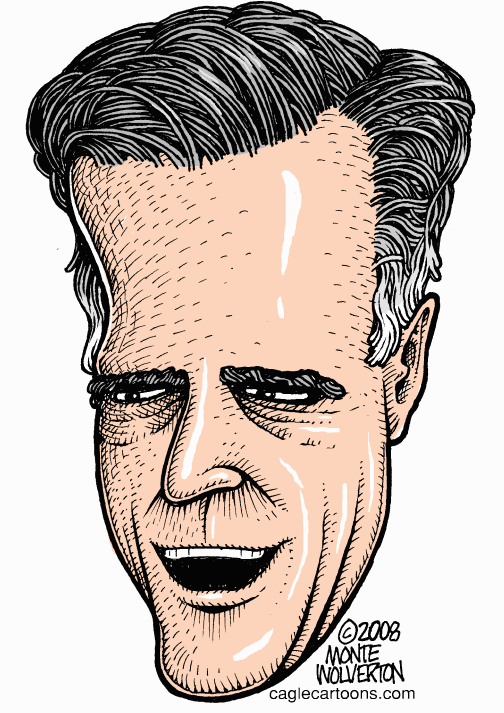
Mitt Romney is out of the race for the Republican presidential nomination.
Romney looked like a president. He had seemingly demonstrated his electability by becoming a Republican governor in the most reliably liberal Democratic state, Massachusetts. So, what went wrong?
Romney and his brain trust made a series of strategic errors that destroyed his viability as a presidential candidate, at least in 2008.
Strategic Error #1: The Incredible Conservative Shift. Intent on running for president and too unpopular to win a second term as governor in Massachusetts, Romney began “re-positioning” himself on issues like abortion and gay marriage. The idea was to make himself not just pleasing or unobjectionable to social conservatives, but, following a series of Damascus Road experiences, to be one of them. Some bought the ruse. (It may not, in fact, have been a ruse. Romney’s earlier positions on these issues, along with his disavowal of being a Reagan Republican, may have been part of a ruse to establish his electability in Massachusetts. We’ll probably never know. Romney himself may not know.) But in the end, too many voters were wary of yet another Massachusetts pol who could, fairly or not, be credibly described as a flip flopper.
To deal with any shifts, real or espoused, on any of the social conservative agenda, Romney would have done better to have announced
his changed positions and worked on their behalf for several years. The shift was too facile, too convenient for a presidential bid this year.
Strategic Error #2: Mitt, the Baptist Mormon. Romney and Company totally mishandled his religious affiliation. In 2005, Romney supporter Hugh Hewitt asked readers of his blog, particularly those of us he calls “Godbloggers,” whether a Mormon candidate for president would be summarily dismissed by Christians. I believe that I was the first blogger to respond to Hewitt’s query. I remain convinced that, while some Christians would refuse to vote for a Mormon for president, for the vast majority of Christians–and Americans–that would not be the case.
The key for candidates for president, I believe, is not to disavow their faith, but, as John Kennedy did when dealing with questions about his Catholicism, to promise that he or she will not give preferential treatment either in policy or personnel to their faith.
Romney seemed to say that in the first part of his now-infamous ‘Faith in America’ speech.
But then, as appears to be his wont, he strove to split the difference. He spoke of America as a religious country, made a confession of faith about Christ that appears to be at odds with his Mormon religion, and seemed to make theism a qualification for public office.
Romney and his campaign were paranoid about his religion. The official campaign biography of Romney, written by Hewitt, who I consider a friend, was titled, A Mormon in the White House?
The book demonstrated the profound ambivalence and uncertainty with which Romney and his handlers viewed his faith. Their response, as well as their paranoia, shows how anxious they were to rebuild the Reagan coalition, building primarily on the Religious Right.
But they misread the political moment. George W. Bush has destroyed the old Republican coalition. The war in Iraq has put neoconservatism, with its Wilsonian Democratic national security stance, in question. The overspending of the past eight years has put Republican avowals of fiscal responsibility in question. Conservatism and Republican politics are ripe for re-definition.
This presidential election year was not the one to pay homage to a dead past, but the year for bold new initiatives that would have recast the Republican Party in the same way Ronald Reagan did for Republicans in 1980 and Franklin Roosevelt did for Democrats in 1932. (Instead, with the probable nomination Barack Obama, the Democrats, almost despite themselves, seem poised to become the party of new, generationally-ascendant, big ideas in 2008.) Republicans need this year, to paint outside the box. Rudy Giuliani knew this, but he was not the candidate and didn’t commend the policies that would bring the “change” everybody, irrespective of their politics, seems to hanker for this year.
In trying to appeal to a socially conservative constituency which is itself, beginning to wonder whether issues like abortion and homosexuality can be effectively addressed at the federal level or in politics at all and whether other issues like war and peace and the economy might not be more pressing at the moment, Romney was eight years late. Like old generals who get outfoxed as they try to fight the last war, politicians lose when trying to win the last open election. Someone needed to tell Mitt that he wasn’t trying to win the 2000 GOP nomination.
In fudging and fuzzing questions of religion and politics, Romney made himself and his candidacy fuzzy and less than credible.
Strategic Error #3: I’m Bush, too. Romney spent the entire campaign as an apologist for George W. Bush. When, for example, Mike Huckabee put a mild slap on the President for arrogance in his foreign policy, Romney affected righteous indignation, demanding an apology. But even many of Mr. Bush’s supporters have been chagrined by the appearance of arrogance in his foreign policy.
Romney defended Bush in other ways. He didn’t need to do that. Yes, the Republican base supports George Bush, to an extent. But, whether as a candidate in the GOP primaries or in the general election, the best Republican strategy in 2008 is to to admit mistakes and differences of opinion and move on.
When, in the pre-California debate at the Reagan Library, Romney was asked the Reaganesque question, “Is America better off today than it was eight years ago?,” Romney tried to shift the focus to his time as governor in Massachusetts. There was nothing wrong with that. He needn’t answer for George Bush’s presidency. But, when pressed, Romney defended the President, claiming that the deficit spending and other very un-conservative policies of the President, weren’t George Bush’s fault. It was, he said, the fault of “Washington.” But it wasn’t some nebulous “Washington” that voted for pork barrel spending; it was Republican members of Congress. It wasn’t “Washington” that signed George W. Bush’s name to virtually every single spending plan to hit his desk. Romney would have done himself a huge favor if he’d said those things. It would have made his assaults on John McCain as a “Washington insider” a lot more credible.
It’s stunning, when you consider it, that Mitt Romney’s campaign went as far as it did. It says something about the power of money and the impact of a network of talking heads pushing a set of ideas at variance with the facts. But in the end, Romney’s errors caught up with him. Maybe 2008 really is the year of change.
[This is being cross-posted at my personal blog.]