

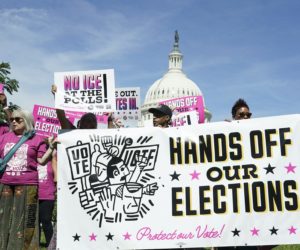

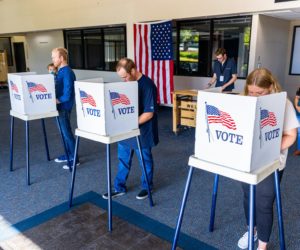


The prospect that a very large number of American citizens who just happened to vote for Democratic candidates in 2008 will be prevented from voting on election day 2012 looms large. How large? A new report says that voting laws designed to prevent widespread voting fraud that by all accounts has not happened in past elections could disenfranchise 10 million Hispanic American citizens from voting — and tilt the election to Republican Presidential nominee Mitt Romney.
New voting laws in 23 of the 50 states could keep more than 10 million Hispanic U.S. citizens from registering and voting, a new study said on Sunday, a number so large it could affect the outcome of the November 6 election.
The Latino community accounts for more than 10 percent of eligible voters nationally. But the share in some states is high enough that keeping Hispanic voters away from the polls could shift some hard-fought states from support for Democratic President Barack Obama and help his Republican rival, Mitt Romney.
The new laws include purges of people suspected of not being citizens in 16 states that unfairly target Latinos, the civil rights group Advancement Project said in the study to be formally released on Monday.
Laws in effect in one state and pending in two others require proof of citizenship for voter registration. That imposes onerous and sometimes expensive documentation requirements on voters, especially targeting naturalized American citizens, many of whom are Latino, the liberal group said.
Nine states have passed restrictive photo identification laws that impose costs in time and money for millions of Latinos who are citizens but do not yet have the required identification, it said.
Republican-led state legislatures have passed most of the new laws since the party won sweeping victories in state and local elections in 2010. They say the laws are meant to prevent voter fraud; critics say they are designed to reduce turnout among groups that typically back Democrats.
Decades of study have found virtually no use of false identification in U.S. elections or voting by non-citizens. Activists say the bigger problem in the United States, where most elections see turnout of well under 60 percent, is that eligible Americans do not bother to vote.
Nationwide, polls show Obama leading Romney among Hispanic voters by 70 percent to 30 percent or more, and winning that voting bloc by a large margin is seen as an important key to Obama winning re-election.
Meeanwhile, the issue of African-Americans being kept from going to the polls in what critics of these laws claim is a 21st century version of the infamous poll tax laws is also a big one — such a big one that First Lady Michele Obama has gotten involved:
The first lady tells a gathering of black lawmakers and leaders that they owe it to those who fought and died for equal rights in the 1960s to make sure every voter can freely cast a ballot.
Her comments at an annual awards banquet for the Congressional Black Caucus come amidst a push in more than a dozen states to pass laws requiring voters to show ID at the polls. Critics say the laws unfairly harm minorities, poor people and college students – all groups that tend to vote Democratic.
Comparing it to the civil rights movement, Obama calls voting rights “the march or our time” and “the sit in of our day.”
Also, read Robert Stein’s post HERE.
Critics note that some of the voter ID laws in some states seem also specifically designed to keep seniors from voting or to make it extremely hard for many to do so.
So Hispanics…African-Americans…seniors…
All that’s missing is an effort to keep college students from voting.
But wait:
In Tennessee, a new law requiring voters to show photo identification at the polls explicitly excludes student IDs.
In Wisconsin, college students are newly disallowed from using university-provided housing lists or corroboration from other students to verify their residence.
Florida’s reduction in early voting days is expected to reduce the number of young and first-time voters there.
And Pennsylvania’s voter identification bill, still on the books for now, disallows many student IDs and non-Pennsylvania driver’s licenses, which means out-of-state students may be turned away at the polls.
In 2008, youth voter turnout was higher that it had been since Vietnam, and overwhelmingly for Barack Obama. This time around, the GOP isn’t counting solely on disillusionment to keep the student vote down.
In the last two years, Republican-controlled state legislatures have passed dozens of bills that erect new barriers to voting, all targeting Democratic-leaning groups, many specifically aimed at students. The GOP’s stated rationale is to fight voter fraud. But voter fraud — and especially in-person fraud which many of these measures address — is essentially nonexistent.
There is always plausible deniability, except no one believes the denials on talk radio, cable talk or on new media websites. But the intent is clear:
None of the new laws blocks student voting outright — although in New Hampshire, Republican lawmakers almost passed a bill that would have banned out-of-state students from casting a ballot. (The leader of the State House, Bill O’Brien, was caught on tape explaining how the move was necessary to stop students from “basically doing what I did when I was a kid: voting as a liberal.”)
And in some states, education officials are trying to limit the damage. In Pennsylvania, for instance, many universities are either reissuing IDs or printing expiration stickers to make current cards valid, according to a survey by the Pennsylvania Public Interest Research Group.
But every additional barrier makes a difference to students, said Maxwell Love, a 21-year-old senior at the University of Wisconsin in Madison. “It’s the little things that make voting harder that are going to affect apathetic students … This is like literally slamming the door on youth engagement.”
Voting advocates agree. “This is absolutely perfectly rigged to prevent students from voting,” said David Halperin, an attorney and former director of national youth organization Campus Progress.
The Republican motivation is obvious, Halperin said. “In general, they would prefer that students don’t vote … They certainly don’t want students to vote in swing states who don’t live in swing states.”Potentially even more damaging to student voter turnout is the confusion caused by new and changing rules, some of which are being challenged in court. “The confusion surrounding it … is the most infuriating thing,” said Love. “The confusion is, like, literally pissing people off to the point where they’re not going to take the time to figure it out.”
The problem:
If an election is a close one and won by keeping away from the polls specific groups of voters who voted for one party last time by the party that didn’t get those groups votes last time based on the premise that there was a widespread problem that actually cannot be found to exist, then you have a real legitimacy problem.
And if you thought 2000 was a controversial outcome, if this happens you ain’t seen nothing yet…..

Joe Gandelman is a former fulltime journalist who freelanced in India, Spain, Bangladesh and Cypress writing for publications such as the Christian Science Monitor and Newsweek. He also did radio reports from Madrid for NPR’s All Things Considered. He has worked on two U.S. newspapers and quit the news biz in 1990 to go into entertainment. He also has written for The Week and several online publications, writes a column for Cagle Cartoons Syndicate and has appeared on CNN.