












There are times I want to grab some tea party folk by the neck and try and shake some sense in them. Many of them are, indeed, unreasonable and illogical. Advocating not raising the debt ceiling, forcing the government to cut about 40% of the budget in one year, may not be terrorism but they might as well support detonating an atom bomb in New York City considering the similar effect it would have on the economy. You don’t snatch a trillion and a half dollars out of the economy and not see a collapse of some kind. And if it is Gotterdammerung they seek, let them self-immolate and achieve their irrational goals that way.
But really, it is ridiculous to call this a “Tea Party Downgrade.” There was never, ever a chance that the debt ceiling wouldn’t be raised. Less than 100 tea partiers in the House and a few in the Senate could never have blocked the Congress from raising the debt limit. In fact, it was useful for both sides to use that non-existent threat in order to try and get their way.
The 11th hour nature of the debt deal was pre-ordained. Both sides were going to take the talks to the absolute limit before papering over their differences and reaching an agreement. This is the way things are done in Washington — pandering to both bases, both sides playing politics to the hilt, until at the last possible moment, order is restored and a deal is inked.
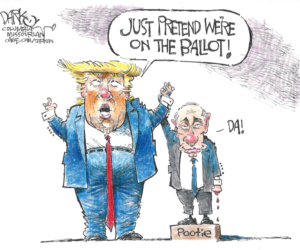
Right now, a gigantic game of “Pretend” is being played by those who are blaming the tea party for what appears to be a political decision by S&P to lower our credit rating. Both sides are elevating the tea party far beyond their actual influence, pretending that they were obstructionist hooligans who almost caused a catastrophe. Or, in the case of Republicans, well meaning activists whose whims had to be catered to on the spending issue lest Boehner and other Republicans end up being primaried by tea party candidates. This is nonsense. The Tea Party doesn’t have that kind of electoral clout. And while they may score a victory here and there (Senator Lugar seems especially vulnerable), their candidates were soundly defeated in primaries against most GOP incumbents in 2010. (They fared much better in open primaries but only 32% of Tea Party backed candidates won in the general election.)
Pretending what isn’t so in this case was extremely useful to both sides; it gave Boehner an excuse to rule out tax increases and gave Obama a foil upon which he could impale the Republicans while agreeing to a deal without an increase in taxes. Obama, running for re-election, knows full well that raising taxes on anybody – even the rich – is bad politics in an election season. It is not surprising that he “caved” on the tax issue — a stratagem, the logic of which has escaped his more rabid liberal supporters.
I can’t believe that John Boehner didn’t know that no deal he came up with would satisfy the radical libertarians and far right wackos who supported sending the American economy to guillotine. I predicted back in May that there was no deal save balancing the budget now, today, that would placate the extremists who are the most visible members (but not a majority) of the tea party. In fact, if they supported any agreement, it would be the end of them. The Tea Party exists to be contrarians, naysaying is their lifeblood. They cannot exist as majoritarians. The movement would collapse under its own internal contradictions if they ever did achieve power. How could a movement that is, at bottom, anti-government actually run the government?
Neither can I believe that President Obama didn’t realize the same, exact, thing. Thus, this game of Pretend where both sides brought us to the brink, playing out their political games, all the while knowing full well they would come to some kind of arrangement – even if, as it turned out, that the agreement was largely meaningless as a deficit reduction deal.
We are not going to address our deficit problems until our economy is a smoking ruin. Every European nation currently at or near default never addressed their problems either and are now paying for the fact that it is not in the nature of democracies to deal with such intractable issues. Democracy is about consensus and compromise. But the politics that fleshes out a democratic form of government is, unfortunately, made up of politicians, freely elected by the people, who can be unelected in a heartbeat if they were to inflict the kind of pain that will be necessary to solve our spending problems.
The Tea Party doesn’t care about the pain. Like small children, they know what they want and they want it now. But this only makes them juvenile delinquents, not terrorists. They might get some credit for altering the conversation in Washington to reflect the reality that we have a spending problem, but their unrealistic solutions should receive our disapprobation.
There is no way to get spending under control without cutting entitlements and raising taxes. The longer we wait, the higher the taxes and the more we’ll have to cut. It’s a matter of arithmetic now. The administration’s own estimates have us running up $9 trillion more in debt over the next ten years. And that’s with pie in the sky estimates of growth and the nonsensical notion that interest rates won’t rise, thus massively increasing the amount we pay to service our debt.
Within this coming decade, the dollar will no longer be the world’s reserve currency, we will probably be downgraded further, we will experience at least another recession – or two – and since neither side has the answer to the crisis, we will probably see a string of one term presidents and control of the legislature see-sawing back and forth every two to four years.
And then? Terra Incognito as the ancient mariners used to call uncharted waters. If I’m lucky, I won’t live to see it.
Without them, there wouldn’t be people distracting the nation with dreams of a Randian America. No TP, no problem.
I know democrats are not allowed to make concise, effective and sufficiently fair soundbites like ‘Tea Party Downgrade’, but rules are for idiots.
Rick Moran wrote:
Never mind that it’s a false equivalence.
More interesting is that the effect is nothing like it would have been as recently as the early to mid 1960s*. New York is not the core of this nation, despite what Hamiltonians in all times might believe (they only truthfully can wish). (The Northeast, for that matter, no longer is the effective core region of this nation.)
* For those with more “capacity”: that includes conventional bombardment from the sea by German military in World War II
I’m also not going to engage in false moral high ground or join the crowd looking at the “tea party” (not the same as the 2008-2010 “movement”) crowd in the House of Representatives or anywhere else for excuses.
http://www.foxnews.com/opinion/2011/08/08/sp-downgrade-will-have-little-affect-on-interest-rates-or-obamas-policies/#ixzz1UT8dIggd
This developed over decades, made worse since November 2008, not truly since November 2010.
I have no need to join the resentful Herd.
Tax increases are necessary and inevitable in the future (because of the growth of the elderly population and the reduced fraction of the taxpayer cohort), but the problem the feds have is spending, and the core of it is entitlements. The need is for spending and especially entitlement reform, not tax increases. Correct, intelligent tax policy requires reform before increases in the new, corrected tax structure.
Will the correct things be done before the 2020s? [shrug] Obama and the Congressional Dems worked hard in 2009-2010 to speed up the need and the date that reform can’t be avoided any longer.
I read this post as a response to one of Andrew Sullivan’s posts the other day: Here it is…
“You know, I don’t agree with you [Andrew] much any more. But you nailed it in that post.
The only real economic (I don’t care about the politics of any of it) solution for what we face can be summed up in one word: time. Lots and lots of time. The single, most important thing we can do is to avoid turning what’s likely gonna be a problem the lasts another 5-10 years into a problem that lasts another 15-20 years.
In that vein (and again, I’m ignoring politics altogether), here is the problem with Keynesian solutions. We’re a debtor country. Every $ of additional spending is an additional $ of debt creation. The marginal utility of each new dolar of debt has been negative for a couple years now. The multiplier effect is negative.
Keynesians aren’t the problem.
Keynesianism isn’t the problem. The problem is where we are. It’s 2010, not the 30′s or 60′s or 90′s or even early-00′s. It can’t work ‘at this point in time’. We’ve stolen growth from the future for the last 25-30 years. The future is here. We’re paying a steep price. We’re giving back some (maybe alot) of what we took over all those years.
The choices made in the next 2-3 yrs will tell the take of whether this mess will end up lasting another 5-8 yrs or another 15 or more yrs. I wish I trusted either party to make the right choices.”
Democrats are no way near as adamant on opposing entitlement reform as republicans are to the very idea of entitlements.
There’s also the weird part about how ruining aggregate demand and the damage this would do to the recovery is ignored, while the reaction to any and all environmental legislation was and is “NOT NOW AND MAYBE NOT EVER – THINK OF THE RECOVERY!”
Up until now the raising of the debt ceiling has been routine. The markets didn’t really react in pat years.
This time around the Republicans indicated back in January that they were were willing to hold the debt seiling and economy hostage in order to get their way. They succeeded, but at what cost? S&P cited one of the reason for the downgrade was the inabilty for the political parties to negotiate. (Even though the Dems gave FAR more than the Republicans gave in on.)
So let me ask everyone this. If the Dems had raised the ceiling last Dec. the Republicans would have grumbled that they had no input. But do you think S%P would have downgraded the US and the markets would have plummetted as they did today?
I think if the Dems had put their plan through – a balanced approach with decreases in spending and revenue raising (such as through closing tax loopholes) the markets would be in much better shape.
“Democrats are no way near as adamant on opposing entitlement reform as republicans are to the very idea of entitlements.”
No it’s just a political football. If either one suggests changes, the other go ballistic. We saw that in the health care debate, we saw that in the budget battle, we saw it in the debt ceiling debate.
Yes, the problem is time, namely the lack there of. We need to act sooner so reform is painful than it would (will) be later.
In 2005, I had said the Dems had the perfect opportunity to seize the initiative on Social Security reform and structure it to their preferences, being able also to claim credit for saving the program and winning many votes as a consequence and reward for years afterward.
(It was also probably the last less-painful chance we’d have to convert the entitlements from Ponzi-scheme pay-as-you-go that will be ruined by future demographics, to fully funded programs. Were the Demmies able, much less willing, to act thus? Nooo.)
The Dems were mindless about resisting all changes, and lying about the state of Social Security currently and in the future.
This budget deal, particularly after political-cover Bowles-Simpson completed its work, could have been the start of reforms, including not only benefits and costs but thorough tax reform including income taxes and FICA. Did they do it? Nooo. They rejected all changes, ignored them in subsequent policy, said that reforms were “unacceptable” (Pelosi), refused to reduce any Social Security payments and thus costs (Obama), lied about the condition of Social Security and said it needn’t be touched for thirty years or more (Reid).
Now, how can S&P any more than we the people have confidence?
Stockboy is correct in his comment. A balanced approach not sabotaged by TP tunnel vision would have been much less likely to lend itself to even more damage. Nothing very hard to understand here, not even the predictable (and unfortunate) partisan apologism. Where did all the grownups go? More lord of the flies.
Well, careful. Real Keynesianism wasn’t practiced after World War II — the policy was to spend money Keynes-style as if were perpetually a depression, while at the same time hypocritically raising (at least nominal) taxes. Real Keynesianism means increased government spending and lower taxes, with government deficits, to fight deflation, during the busts, and reduced government spending, higher taxes, with government surpluses, to fight inflation, during booms. (The surpluses during booms could ideally be put into a reserve fund to pay the extra spending and deficits during busts.)
It’s true that it’s not the 1930s with a perceived need for what then was revolutionary (our third revolution) federal government interventionism, and it’s not the 1960s with great growth off which a growing already-oversized federal government could easily parasitize. Late 1960s, 1970s, into the early 1980s, the failure of all this excess (and wrongful policy) hurt us so badly.
It’s loony to believe we need to be so stupidly regressive that we should go back to believing now is like those times.
These times are different. We’re closing on the 2020s and the start of an uglier economy, with population aging, exploding entitlement costs, labor shortages, big bear market in assets of may kinds as those with assets sell them to pay for retirement.
Add to that the obvious Era of Limits — unlike so much claimed by environmentalists, these limits are real. It’s the limits to what can be taxed or borrowed to have government pay for, as well as the limit to federal encroachment into and takeover of proper state and local government functions, as well as governments crowding out unnecessarily the private sector, and of course the limits to expectations people should have of government, that it’s not true that government can and should substitute for the family.
Well, we’re facing our limits to government earlier than should be the case, because of misspending and other misdeeds after 2008, making a bad situation worse. We’re running out of time even more quickly than before to try to get things in reasonable order and under reasonable control before the really ugly times start, and we’re throwing away that chance(, too). Things are to the point now where we seriously must anticipate austerity measures.
Let’s not use weasel, euphemistic, feel-good language like the word “balanced” so many Dem politicians have been using, when trying to seek tax increases, which aren’t the major part of any serious solution to the problem, which is excessive and mis-spending, notably spending on entitlements.
It may make some suitably susceptible people feel good, but that has no intrinsic or extrinsic value. In fact, it’s a definite liability.
The Stoxster wrote:
But that’s simply economics as well as political and other forms of justice. The problem is spending, particularly for entitlements, and the solution lies wholly or mostly in reducing and controlling spending, notably for entitlements, whose reform is long overdue.
That’s simply conceding to reality. It wasn’t conceding too much — the lib and Dem demands were unrealistic as well as morally defective (class warfare as well as gimmicky, not real tax reform).
And there’s little serious concession for anyone grown-up to be upset about. Spending is the problem, whereby “insufficient tax revenue” is dwarfed. (And what libs and Dems wanted was not reform, more important than raising taxes.) Entitlement reform, the core necessity, was avoided! There was no major concession.
Grown-ups have every right to be disappointed or more-and-worse, in fact, because entitlement reform was avoided, the most crucial element in any serious budget plan. General spending came second, and tax reform third. Tax reform is important, simply raising taxes not so.
From the S&P report:
So it is a pox on both parties but they specifically call out the Republicans. Letting the Bush Tax cuts expire is not raising taxes. The 2001 bill was designed to be temporary until the surplus was exhausted.
The TPers may have added the gross floating object to the punch bowel, but free spending Reps and Dems were doing the swilling and porking for quite a while. They don’t deserve all the blame, but they sure got our attention.
Cut defense and farm subsidies, and, corporate welfare tax breaks, not entitlements. Raise taxes on the rich to 90% again if that is what is required. We DO NOT have to cut entitlements.
Allen, how about a deal. You get Washington to drop the 57 cent/gallon tariff on ethanol with a bipartisan vote, and you can keep the savings you will rake in on lower food prices.
Fair, win, win for Reps and Dems (tell S&P about that).
Note: corn is now $7/bushel and scarce.
P.S. The $5 billion a year subsidy goes to the refiners (yes oil companies).
I’d really like to hear DLS’s idea of Tax Reform.
It would be a package of tax “incentives” for business and the cutting of tax deductions for families.
Don’t be sold by the word “Reform”. To a Tea Bagger like DLS, it means a family tax deduction is the slippery slope to the nanny welfare state.
The only people we “nanny” in this country are the rich capitalists.
Stick with the President, he is trying to fight the greedy and he is doing great I think.
Ron, this was already address. The Bush tax cuts aren’t and never were the most important problem; the problem has been spending, especially on entitlements, and that’s where nearly all reform must take place. S&P was equally or likely more concerned about the partisan bickering over the inadequate budget deal it managed to approve at the last moment; they (S&P) like anyone else evaluating a nation’s credit is naturally concerned about political instability and risk. (They’re concerned, among other things, that this deal could be soon undone, as well as concerned about more bickering when the “super-commission” meets, as well as if their work will be disregarded by Obama and the Congressional Democrats as Bowles-Simpson’s work was.)
Duck-
Well then, I’ll remember to say a kind word at their execution.
Huh…………………………..
Common Sense says:
When it comes to marketing business, you market those with money not those without money. Same with taxes, you target the rich or otherwise you go broke.
Duck-
No ethanol Duck. Burning food while human beings starve is against God, and, humanity. We are under God and supporting humanity, remember?
Huh, squared………………..
“Democracy is about consensus and compromise.”
As the old saying goes, “It takes two to tango”.
Well, Allen, currently you’re reading as badly as you’re thinking.
(But some others on this site are doing just as badly, so don’t cry.)
My tax reforms have been on record numerous times. The principal part is the income tax reform, which eliminates all exceptions, disparate treatments, and other special favors in the tax laws, and which thus permits lower rates, eliminating the need for the alternative minimum tax for individuals or households, and placing corporate tax rates closer to the median, and hopefully below it, of OECD corporate tax rates and burdens.
The correct income tax is a single-rate or “flat” tax with a reasonable exemption for basic living expenses, that ought to be matched by minimum Social Security payments and similar forms of assistance, as well as the 2000-hour annual effective amount of renumeration at the federal minimum wage. (This should come from additional poverty research and related lower-income research.) If there are more than one tax “brackets” and rates, the top rate should be fifty per cent or less. Greater is slavery and moral failure. (It also will result not only in huge disincentives to work, save, and invest, but in a great deal of tax avoidance as well as evasion.)
The correct income tax, with a single rate, results in gently decreasing marginal rates, which is what is superior (even was stated in Treasury’s publication in 1942 for raising taxes greatly to pay for World War II). It might be possible to have a progressive income tax if the feds were desperate for money (this after all necessary overdue reforms were in place and the feds shed much of what should be done by state and local governments, or by the private sector, instead. Much of Medicare is paid for out of general revenues, which so many ignorant people don’t know and which many other failing people neglect. These general revenues are primarily obtained from the income tax (and if government were unreformed and more desperate and venal, a wealth tax someday). There is a way to have a progressive income tax that is the best, which is to have as many rates or brackets as possible for the best or “finest” precision. The way to do this practically is to classify incomes by the closest percentile in the previous year (fractions could be used if more precision were wanted), and part to (too greedy) all of the difference between the flat-rate marginal and constant marginal rate be added as tax, That is, it would be a less decreasing marginal tax or (at greedy maximum) a constant marginal rate tax. (It would be better if the feds took no more than 50% of the marginal rate decrease from the flat tax with the exemption.)
FICA taxes needed to raised to 25 per cent to make Social Security and Medicare (FICA-funded parts) solvent. The first thing to do, though, is to raise or abolish the FICA income “cap” as well as subject all forms of compensation to FICA tax. Raising the cap or abolishing it only delays more-serious fiscal problems (when the trouble really starts, not the much-later phony “trust fund exhaustion” — the programs are running deficits already, which requires money to be found elsewhere to pay benefits in full) by 6-7 years. (Obama’s FICA decrease was part of why Social Security is running deficits already rather than starting in 2016. That was irresponsible.)
If the FICA cap is raised or ended, benefits morally must be adjusted upward for those having to more tax. The benefit structure is not linear but substantially decreasing the higher one’s income is — replacement rates go downward with increasing incomes that are taxed. Presumably a “bend point” could be added at or near the current cap to keep down the size of the higher-income taxpayers’ additional benefits if cost control is essential with this. An alternative is to taxes paid and benefits “paid for” [sic] incomes up to a raised FICA cap that’s realistic for today, which is around an annual income of $250,000 (the modern “tropopause” of incomes, where high incomes truly begin).
A change to entitlements fraught with risk and moral failure would be to shift funding of the entitlements more from FICA (with a possible FICA tax reduction) to general revenues (as with 75% of Medicare Part B not paid for by the phony “premiums”). The real danger is that the shift will be done without raising income taxes or other general-revenue taxes at the same time. The worst of the worst would just want to make all entitlement funding “mandatory” out of general revenues (and repeal FICA and its taxes), without raising taxes at the same time. Such by the worst of the worst would probably be (dishonestly) claimed to have solved the entitlement funding with taxes, permanently.
Before that danger is reached, we’ll probably see serious tax reform, such as I’ve described, as I have more than once on this site. I normally ignore or disparage out-of-place unreasonable demands, but I was nice enough to explain tax reform again here.
You’re welcome.
Allen, consumption taxes are superior to income (or wealth) taxes.
The greatest tax reform possible would be to abolish the income tax (and repeal the amendment to the Constitution that made it legal, without any per capita requirement) and convert to a consumption tax such as the VAT.
Now if we’re taxing income or wealth, that’s what gets taxed, all of it except possibly an exemption for basic living expenses (what we do now) or even higher if typical lib Dem vote-buying and additional favored-group privilege-granting is sought so often.
That means all incomes, all forms. “Income is income, from whatever source derived.” Those with higher incomes (or more wealth with a wealth tax) pay far more in taxes than they get in any (honestly) conceivable set and amount of benefits from the taxing government, and the low-income people pay less typically than what they receive, but if it is an income tax, that is how the payments go, in theory. (It’s wrong for governments to demand more, to want more than the same proportion for each and every person or household; progressivity is inherently unjust.)
This is an excellent article. Too bad the mainstream media is more interested in spreading the fantasies of political parties and politicians than preparing people for reality.
Allen, more clear-thinking needs: don’t rush to wrongly bash biofuels strongly for “the rich North” harming “the poor South.”
So many other things affect food prices…
http://books.google.com/books?id=Ru3RUTbJCI8C&lpg=PP1&pg=PA21#v=onepage&q&f=false
[...] the time to …Sen. Graham: Obama's 'Lousy' Leadership Wrecked EconomyNewsMax.comHow Much is the Tea Party to Blame for the Downgrade?The Moderate VoiceWe have to stop living beyond our meansGaston GazetteGwinnett Gazetteall 574 news [...]
Reality-
Reality is not republican.
I agree that if they had put such a plan through, we’d be in better shape. But their instincts seem to pull them in the other direction.
Ethanol is the biggest, stupidest waste of money ever. Even if it wasn’t a waste of energy to produce we’d need several times the total acreage of the US arable farmland to actually make enough to be an alternative fuel source. Why this continues to be funded is surely political lobbying at its finest/worst. Did you vote yes for ethanol? Then you are being bribed by special interests and should be replaced.
DLS has a strange idea of what it means to address an issue. The Bush tax cuts are in fact part of the problem. So are the loopholes, corporate welfare and agricultural welfare. Frankly I think it’s more than a little likely that if those crying for a balanced budget got their way there would be an immediate call for tax cuts because if the budget is balanced then of course the government is taking in too much money. Sound familiar?
“The Tea Party exists to be contrarians, naysaying is their lifeblood. They cannot exist as majoritarians. The movement would collapse under its own internal contradictions if they ever did achieve power. How could a movement that is, at bottom, anti-government actually run the government?”
I think you misunderstand the tea party, which is a mixed bunch, and libertarians. It’s much easier to run a government that has a few purposes better than one that’s trying to fix everything at once. According to your view, Apple would succeed better if it bought Monsanto, GM, and Dollar General.
No, Prof, he does not misunderstand the Tea Party. I think that honor would have to go to you. In the beginning of the movement you might have been right but that was a while back. As time went on it homogenized to represent only the most extreme opinions, including extreme social conservatism. Look at what Republican candidates have said in order to appeal to them if you want a sense of their desires, especially Bachmann. It has been seriously said by some of them that the debt limit should have been cut instead of increased. Many of them are already speaking of getting the conservative lawmakers that they feel betrayed them.
Jim makes a good point. I think a few people here have idealized the Tea Party, probably because they had hoped it would represent more well reasoned interests and fewer bizarro world elements. In fact it is doing more harm than good, which may well result in it’s demise at the hands of a freaked out electorate.
Sure Jim, I bow to your obviously superior knowledge. After all, you’re in the thick of all the media coverage, while I’m just a core planner for a single group.
Hi Prof, considering that small groups like yours have lost control of the TP brand, have you considered rebranding yourselves…getting away from what Fox News created and making your group relevant again?
You and your group was TP before Fox News ever got involved. I fully believe you are the real deal and your opinions are worth considering. As long as you are part of the “Tea Party”, you’ll never get the respect you deserve…because those that have followed you are simple idiots latching on to a Fox News brand.
@ShannonLee(e)
The TP “brand” wasn’t lost — we never had it. We can’t control what the media says, but we can control what people see.
So, we invite speakers that inform, such as our state’s department of local government, town trustees, and political candidates, although the Democrats have worked hard to keep even the few willing candidates from showing up. We had a “what the pledge means to me contest”, both to get kids involved, and to reach out to others.
But no matter what we called ourselves, the press and the parties know who we are. If the they say one thing, and people find something completely different in the real world, whose image suffers?
Please explain why we need pledges. How about, I will try to do the best for the country.
Yes, Prof, you are part of the group. You have your loyalty to them. You also, IMO, are not seeing the forest for the trees.
Terrific analysis, Rick.
And DLS, you have reached new levels of boorishness in this thread.
Prof., I am not trying to be disrespectful of your group, I sincerely was just wondering.
“Pretending what isn’t so in this case was extremely useful to both sides”
The absurd level of attention to Palin is also because the controversy is useful to both sides to rally the troops. For all that they are engaged in a no-quarter struggle, the partisan war also has a weird synergy between the parties. Among other things, demonizing each other sets the grounds for excusing their own behavior.
@DDuck
Sorry, I thought you were kidding around. The contest was just a way of getting kids to write about the pledge of allegiance. Admittedly, it was a softball of a challenge.
Thanks,I misunderstood, I thought is was a pledge to do, or not do, something.