















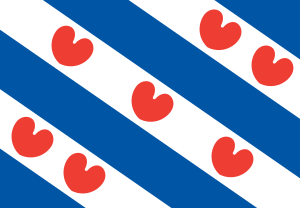
Fryslan
![]()
Yesterday Holly and I were having an e-mail exchange about the Dutch and German languages. She told me that she would like to learn both languages (since they are closely related to each other). The conversation changed from the Dutch language to the Frisian language. The Frisian language is the language of my father. I am not ‘just’ Dutch, I am Frisian. Most foreigners, especially non-Europeans, never heard of ‘Fryslan’ (or, in Dutch, Friesland) (nowadays a province of the Netherlands), let alone the Frisian language and culture.
So, for those who want to know more about it (and thus more about where I come from), here is a link to a Wikipedia article about the Frisian language (in English) and here is one about the West Frisian language (spoken in most of Fryslan in the Netherlands). Lastly, here is a Wikipedia article about Fryslan.
Share This
Michael, I had been meaning to ask you about this thing that happened with the faux independence of Flanders. If I trust that foreign media covers Netherlands news as well as they cover Spanish issues, then it’s quite possible that reports of the matter are wildly exagerated or at least misguided. I’ve read everything from it causing widespread panic to it not even registering with most people until after the fact. How was it really lived? Did a lot of people really get fooled? A dutch man visiting in my lab this week told me that people advocating independence were but a small minority, so that the issue isn’t as fraught with tension as it is in Spain (where we have to deal with a less than charming terrorist group with over 800 dead at their hands, including 25 children). What is the general opinion on the matter? If something like that happened in Spain heads would roll.
Nice flag, though the red markings look a little like hearts, or maybe hoof marks from the uber-famous Friesland cows
Done some reading on the wikipedia. Well, having sufficiently proven my geographical-political ignorance, I take back my question and return Flanders to Belgium, where it belongs. I’ll just go cover my head in shame now.
Lynx, LOL… yeah, it’s kinda…. umh.. a different country.
So how’s it going with the IRA in Spain? O… wait…
LMAO!
Anyway, many Dutch people think that the Frisians want to be independent as well. Which we don’t. We are simply proud of our culture and rich history and beautiful language.
I’ll never forget the first time I heard West Frisian spoken. I thought I was hallucinating. It sounded very much like English and yet I could barely understand a word of what they were saying. An eerie experience.
Dave: yes the Frisian language and English are very closely related. Both are northsea germanic (which only comes in two shapes: english and frisian). They sound very similar.
Also… did you concentrate on it for a while, say an hour? If you do I’m quite sure that you start to recognize certain words.
So what kind of Frisian are you speaking? I assume you also speak Dutch, German and English?
West Frisian. Yes. And French (a bit). And I wás able to speak some Spanish, but due to lack of practice… it has become really, really bad.
I love this stuff. Michael, tell us more about the various provinces of “The Netherlands.” Most Americans have no idea what the difference is between “Holland” and “The Netherlands.” Give us some more background on the old United Provinces!
Interesting, Michael, and I see that you come by your pro-American stance naturally
:
I had 4 years of high school Spanish and can decode some of what I read but very little of what I hear. I also have a bit of Hebrew, Aramaic and Yiddish.
I’m woefully and ashamedly linguistically uneducated (two years of high school French only) but I can definitely identify with Holly’s comment about decoding more in print. Even with my limited knowledge I can understand quite a bit of Spanish and French in print but it all sounds like complete gibberish when I listen to the spoken languages. I’m sure that immersion in a language and greater listening experience would help but I’ve often wondered to what degree I may just not have an ear for languages (I’m very much a visual learner anyway, have a nearly photographic memory but my auditory processing is not great).
Inmersion is definatly the way to go. You should all come over to Spain. We’re the original speakers of the language and we really know how to live
I’m actually ashamed to say that I’ve never studied a language, per se. I grew up hearing Spanish (mother) and English (father) and have spent approximately half my life in Spain or the US, so I became bilingual naturally. I was lazy enough to go to Spanish classes in High School in the US and English classes in Spain, where I spent my time helping other students and occasionally pestering the teacher on mistakes. I now regret not having taken advantage to learn a third language. I’m studying Japanese now, but it’s very slow going.
Speaking Spanish is helpful for Italian, which is similar enough to learn quickly, or for reading Portuguese, which has spelling and grammer VERY similar to Spanish but is more difficult to understand than Italian, when spoken out loud.
Michael, is their a national language in the Netherlands, does each region only teach it’s language or are both required?
C.S.: yes, that is true. Fryslan was the first to recognize American independence. Many Frisians related to America (and actually moved to the US).
Elrod: thanks! As a true Frisian, I enjoy writing about it and answering questions so here it goes: Holland are two provinces: North Holland and South Holland. Many people refer to the Netherlands as “Holland” (including Dutch people), but its factually wrong. The name of the country is the Netherlands, not Holland (that would be if the US is suddenly called New York for instance).
What more do you want to know? The Netherlands consists out of, formerly, independent lands. They – mostly and mostly voluntarily – united to fight the Spanish.
The Romans conquered a lot, but were not able to conquer ‘us’ (the Frisians). The idea that Frisians are easy going peaceful, but stubborn and when provoked fighting people stams back from that era I believe.
Holland tried to conquer Fryslan a couple of times. Mostly failed. Some argue that they conquered us, others say that we decided that it was mutually beneficial to work together.
Guess who says what?
Lynx: there are 2 official national languages: Dutch and Frisian. The trouble is that Frisian is only spoken in Fryslan. However, when in a court of law or a governmental building one is allowed to speak Frisian and to file papers written in Frisian andsoforth.
As an Indo-Europeanist, it is intersting to note how similar the northern European Germanic languages are. Because the small areas were still defined when writing came into being, their internal changes froze a bit, and they influenced each other slowly. Because of property rights, they tended to be more stable groups than linguistically related groups in other parts of the world. Thus, Swedish, Norwegian, and Danish are not really separate languages, they are dialects of Scandinavian and mutually understandable.
If linguistic study had originated in China and they were just discovering the NW European languages now, they might insist that all were merely dialectical variants, because mutual comprehensibility of simple conversation can usually be achieved in a few weeks.
Fortunately – I think fortunately, anyway – Europe was ascendant, and our small differences seemed large to us, preserving cultural history.
You would not adapt as quickly as a speaker of Dutch, but as a West Frisian speaker you would also pick up Afrikaans quickly.
Frisia is actually divided between 2 countries, Germany and the Netherlands, or if you prefer, East and West Frisia. The amusing thing is that East Frisian (the German part) is considered to be a dialect of German. West Frisian is considered by the Dutch to be a separate language. The two are however nearly identical (or least much closer to each other than to either German or Dutch). It’s all a matter of perspective I suppose.
BTW, I should add that in Germany East Frisians are the butt of jokes that call them dumb. I think every country has some part or neighbor to serve as the butt of such jokes. In the US it’s Italian and Polish jokes.
Waterlily leaves, please.
Here is a famous Fryslan saying for you that as easy for English speakers to figure out. “Better de boat los as de man”. The people of Fryslan have a long history of seafaring and I think it captures their attitude well.