
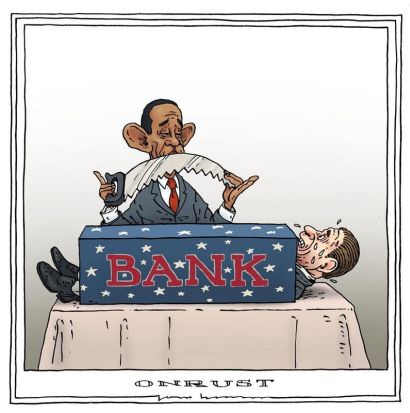
The backlash against decades of American lecturing of Europe about the evils of state intervention into the free market shows no sign of abating.
This article by columnist Thomas Fricke of Germany’s Financial Times Deutschland provides fresh ammunition for Germans who want their friends in the U.S and Britain to shut up once and for all.
For the Financial Times Deutschland, Thomas Fricke writes in part:
What haven’t we had to listen to from our friends on the other side of the channel and great pond about how we in Germany adhere to the terrible belief that the government might be able to help? What haven’t we heard about how we should watch Americans and British shine with much lower public sector shares of gross domestic product (GDP), as well as much lower debt?
That’s all in the past now. Since the mega-financial crisis broke out, more than a few doubts about the healing powers of the market have been circulating among our friends.
The power of the American state has become involved with banks, placed quasi-public mortgage lenders [Fannie Mae and Freddie Mac] under government conservatorship, become the majority stakeholder of AIG, the world’s largest insurer, and summoned auto-manufacturing CEO’s to tell them what to do. It has also distributed more money to the unemployed and launched economic stimulus packages that make Angela Merkel look like a Swabian housewife.
Now, one could say that this was self-defense – a crisis of the century. But that doesn’t change the end result.
In both the U.K. and the U.S., a higher percentage of the population is employed by the state than in Germany. Meanwhile, George W. Bush contributed to this, with his reform of health insurance for seniors, so that now, this item alone takes up more than 1.5 percent U.S. GDP than in 2000
According to estimates by the Organisation for Economic Cooperation and Development, American government institutions require more money than all 16 European nations combined.
Budget deficits in the U.K. and U.S. are now twice as high as ours. It’s a historic turning point: Following the U.S., the UK has now surpassed Germany in total national debt.
READ ON AT WORLDMEETS.US, your most trusted translator and aggregator of foreign news and views about our nation.