














« Split Between Progressives on Health Care Reform Continues
Poll: Support for Health Care Reform and Obama Go Up in December 6 Percent »
Put aside any questions you may have as to whether global warming exists, is a problem, or is created by human beings. Too much carbon dioxide in the atmosphere isn’t a good thing for the planet, whatever your views of global warming.
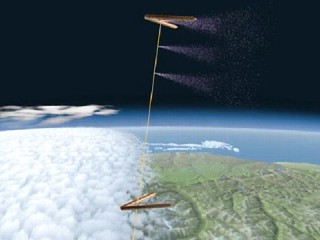
Nathan Myrhvold is accustomed to thinking differently about problems. The former chief strategist and technology officer at Microsoft has several plans for dealing with global warming. One scheme, which seems plausible as he explains it, would call for sucking CO2 out of the atmosphere with the equivalent of high-tech garden hoses at the earth’s poles.
Now, being an Apple man, I treat just about anything that comes from a veteran of Microsoft-world with–I’ll be honest–derision. I love the “I’m a Mac and I’m a PC” ad campaign by Apple, mostly because, having suffered long with a proliferation of PCs and then gotten first, an Apple desktop, which is still going strong after six years, and then, an eMac that has been fantastic over the two-plus years I’ve had it, the ads ring true.
But Myrhvold offered some intriguing ideas for dealing with global warming yesterday on CNN’s GPS with Fareed Zakaria.
Zakaria’s and Myrhvold’s reference to a sort of post-Christian environmental Calvinism that insists that cleaning up the planet must hurt is, I think, interesting. Over the long haul, doing anything worthwhile entails costs. But if solutions are workable without hurting people in Third World countries, particularly, the lack of pain is no reason to immediately dismiss an idea.
[This has been crossposted at my personal blog.]
My main point was not BS, as you put it. My main point about a “liberal conspiracy” was that academia is bought and paid for by the left – period. That's really not such a “conspiracy theory”, since those I know within academia (including my own experiences with blackballing) have shown it consistently.
I know all about CO2 and greenhouse effects. If we take ANY of the naturally occurring atmospheric gases and increase them too much, it will have detrimental effects. That's a no-brainer.
The left is one-sided on this one. Oxygen balance, nitrogen balance, and C02 balance (among others) is crucial for a stable atmosphere.
And 2013 is YOUR point of no return?
Why 2013?
You are making the same mistake some of your more liberal colleagues are making. Your “global warming” cannot be intrinsically measure in one or two years. We've only been measuring it for 70 years – not even close to one cycle.
The ONLY verifiable information we have is historical/geological data which show definitively that heating and cooling cycles exist.
2013 is easy. The last 7 or 8 years has seen little warming most likely due to decadal oscillations, the lowest solar activity in several hundred years and two strong La Ninas with one weak El Nino. So 2013 is the time where if there isn't significant warming then the averaged temperature on the timescales that they use for talking about climate (5-15 years depending on application) will have flattened off completely or decreased. Plus the sun's activity should have increased by then and we'll have seen another El Nino and La Nina (most likely). Thus if the trend has really stopped we should know by then.
Now you may argue that the trend not stopping doesn't mean that it's due to human influences, which is true, but a lot of people are saying that the trend has stopped, and we'll know then. So my 2013 is not over one or two years, it's picked precisely because of when the temperatures currently plateaued and that they show two shorter term cycles.
Again your historical/geological data is about measurements not mechanism. I hate to sound like a broken record but you haven't addressed that at all, especially the part where the study that you were using to back your statement was authored by someone that believed the mechanism was solar forcing…something that other scientists believe can't be responsible for the last 60 years of warming because it's stopped increasing.
“I know all about CO2 and greenhouse effects. If we take ANY of the naturally occurring atmospheric gases and increase them too much, it will have detrimental effects. That's a no-brainer. “
Yes, exactly that's what I have kept saying about why it's important to keep track of, and how solar and orbital oscillations don't account for the past few decades of warming. So what is your definition of “too much?” The scientists are pressing for peaking at 400-450 and going back down to 350-375. If we don't change our current emissions growth then we'll get up to 500-650. Do you disagree that is too much?
Tons of the research and measurements that are done in the US about this issue is by NOAA, NASA and the Navy. I must have missed the memo about how they are all bought and paid for by the left, especially since the latter two have strong military incentives.
The club of Rome model type stuff predicted limits and political consequences would be hit later this century, starting around 2030-2070. You really are going to go out on a limb and say it was all wrong when you look at the massive shortages in water and energy and the demographics problems we're having right now?
Solar activity is NOT discounted in current models, it's one of the main parameters. Geez louise. The sun's activity has not increased since 1950 and that's the argument it can't be due to the sun for the last six decades.
“Additionally, I guess another undocumented solar cycle accounts for the Little Ice Age too.”
Uh, yes but not so undocumented. You'll notice a very strong correlation with reconstructed solar activity and the little ice age.
Now there are some people that believe that solar activity is going to diminish, but that doesn't say anything about the validity of AGW, if it diminishes and you plug that into the models then the output diminishes. If you want to attack the models as being a poor predictor because of what they assume about the sun and have evidence the assumptions are incorrect then that would be a very valid point. I haven't heard any critique like that though.
“The CRU emails poo-pooed by the warmists really does show active attempts of scientists, to withhold data, manipulate the historical record, and to bully scientific publications from publishing counter arguments.”
Even the prominent scientist skeptics like Pielke say the emails are a tempest in a teapot. Did you even read my post on that that I linked?
Maybe you're right about the clouds, I dunno. If you can make a model that works like that then feel free.
As I said in the CRU post, it's long past time that they made all the adjustments and models — every single step — completely available so the skeptics can make their own models and adjustments with different assumptions. I think that is immensely important, and for all I know other mechanisms will be able to explain the warming. I'm not saying that it's impossible, I'm just saying that the current objections have flaws in that they have already been studied (or have foundational flaws like the argument that since the environment has changed in the past that this means we're not doing anything now) and the model of that mechanism didn't seem to explain the current warming.
I am very critical of the assumptions of the current economics, but instead of just complaining about what it can't predict and whatifs, I support the alternative explanations and models that have very concrete mechanisms and which Steve Keen amongst others have used to make alternative models with the different assumptions and showed that it emulated what we see far better than the standard models. THAT is how you attack a consensus theory, make a better one. If you do that I would be on your side in an instant, but it's just not there.
“… you look at the massive shortages in water and energy and the demographics problems we're having right now[.]“
The shortages that are being hyped by some (and any solutions to water and energy shortages fought), and the problems such as in the USA and the West that will be worse later, affecting government retirement programs, that their defenders routinely deny? (The same kind of hypesters, opponents of progress, and deniers of real problems, I notice.)
We'll see water shortages that are for real later, not only in the Middle East but here in the USA. (As I've already written elsewhere, I'm currently again in the desert Southwest and being able to live here for a while before the [real] water shortages happen and it affects everybody's lifestyle.) We'll also see demographic problems and related problems, like other states besides California becoming notably crowded and expensive and growing nevertheless. (Look to other southeastern locales in addition to Florida, as well as to northern Florida and its Panhandle, including the zone where cooling degree-days exceed heating-degree days because of the mild winter weather.)
The Club of Rome and the predictable response to it that made most of the news was another example of hype and alarmism-catastrophism, which was used to rationalize those oh, so familiar Sixties goals.
mikkel
“it's one of the main parameters. Geez louise”
If solar cycles are incorporated into the models and the sun's effect is negligible since 1975, what even theoretic kind of solar activity could be responsible for the MWP?
This was my point. If the sun can be discounted for the past 25 years worth of heating, AND co2 levels were not much higher around 1000AD, how can you make the explicit statement that co2 is the primary cause now. The AGW argument is circular. It's due to co2 now, but it was due to the sun 1000 years ago. At best, your argument points to a third, unknown cause. Why bet the world economy upon a circular argument. After you find a suitable explanation for the rise, please tell just what brought the little ice age hard after. Mann's solution was to minimize these two huge variations as insignificant blips of statistical irrelevance.
“I'm just saying that the current objections have flaws in that they have already been studied”
A shame you don't have the same complaint about the AGW theory. At least the skeptics haven't blocked papers running counter to their beliefs. As much as the warmists want the purloined emails to just go away, there is plenty of evidence that papers submitted to scientific papers were discussed by the group, and suitable response papers developed prior to their publication so as to minimize their effect. That is ethically wrong. Gate keeping of scientific papers are not done through bias.
You clearly know the scientific studies of Mann, Jones, et al, but have you read their discussions how to minimize past temps and cut off proxy series endings to make their cause seem right?
You mentioned that solar activity was a close proxy for temps until 1975, what if that proxy study was curtailed on graphs at 1974? Would you call that good science? This is what was done by these guys.
Show the raw data, look at all available proxy series, and provide the raw surface temperature data. Let learned statisticians, climatologists, and any other trained person examine that data. Replicate each other's results, change opinions according to the results. Science in the open.
If that would be done and AGW is found, I'll back it completely. Kill the raw data, manipulate it's weighted significance, block counter hypothesis, and ridicule people who find problems with your methods, you have something more akin to the proof of WMD under Bush than you do science.
Thanks again for your time and patience.
“So what is your definition of 'too much?' The scientists are pressing for peaking at 400-450 and going back down to 350-375. If we don't change our current emissions growth then we'll get up to 500-650. Do you disagree that is too much?”
Well, at least you didn't refer to a “runaway” greenhouse effect, which is hard to achieve when we start getting clouds and increasing our albedo once the humidity reaches the saturation (dew) point.
(Note that water vapor is a far more powerful greenhouse gas than carbon dioxide is).
Is 400-450 ppm too much, or 500-650? Certainly not for plants, for which 1,000-1,500 ppm is ideal.
OK, but what about us? Well, I'd say that based on what is known about likely effects of warming, there could be “too much” in that it would be difficult or inconvenient for us to adapt to (I'd also be concerned about the tropical areas subject to desertification). But there obviously (as any map of former warmer and wetter areas of the world than they are, today would show) are benefits as well as costs. (In our part of the world, which always will matter most to us, as we live there, the eastern part of the USA stands to do quite well, as does eastern Canada; the West stands to be more arid, though the situation is complicated, including a possible change to the North American Monsoon that affects the interior Southwest. The West overall likely will suffer, notably the West Coast, especially California.)
It's impossible to say what is “too much,” in particular, because we don't know how bad things could get and it's ridiculous to assume much worse than what is known well and what is known to be likely.
More importantly than that, it obviously has never followed logically (even from the most ridiculous instances of apolcalyptic scare-mongering) that we “should” rush (itself, illogical) to adopt the agenda of those who want (and use “global warming” merely as their latest, and hopefully effective, excuse) drastic (instant DQ) radical (instant DQ) inhibitions and reversals of progress (instant DQ) and a long-sought reengineering of our economy and society to meet leftist dreams and demands. (Instant DQ.)
“for peaking at 400-450 and going back down to 350-375″
This is in no way proven necessary, of course. And more importantly, aside from why, how do people propose to do something so unrealistic as to be practically impossible, by definition? (That's without facing the right of the undeveloped nations to develop and progress as fully as we have already.)
“historical/geological data which show definitively that heating and cooling cycles exist”
This includes human history and the Medieval Warm Period, or the Optimum (note name choice).
“Show the raw data, look at all available proxy series, and provide the raw surface temperature data. Let learned statisticians, climatologists, and any other trained person examine that data. Replicate each other's results, change opinions according to the results. Science in the open.”
Yes. Do you think I haven't done a good enough job of explaining that is my position?
Why do you believe that is practically impossible? There are many maturing technologies that have nearly identical cost/kwh over their lifespan as coal, not to mention the myriad of building/insulation/blah blah (I know you know everything so I won't bother continuing the list) that save tons of money over their lifespan. That is a huge chunk of the problem addressed, and I've read you advocating alternative transportation energy stores in the past as they are developed over the next 20 years.
“Why do you believe that is practically impossible?”
For the world as a whole, I just scoff right away at it. World population growth retardation and eventual stasis, the decline, is possible (amazing to Sixties types, but true) — we've already seen this in numerous countries. (Note that that this itself implies a brake eventually on energy use and emissions, though not reversal.) If you look at the portion of the world that is undeveloped currently, and what it takes for them to modernize now, and what realistically we can expect to do with our own (developed nations') energy use and emissions now, there's no way that we can expect to sharply curtail emission growth, then total emissions, then reduce them. That's unrealistic, just like starry-eyed promises disconnected with the facts (and with the responsibility throughout the projected time period to accomplish it) that politicians make and activists say we should achieve, for emissions reductions. This is without additional irritations like
the likely outbidding and one-upsmanship that some politicians, and multiple nations, are tempted to do. Why take that seriously?
“There are many maturing technologies that have nearly identical cost/kwh over their lifespan as coal,
Well, right now, if some cost problems were addressed, nuclear power still looks great for electricity production (a nuke and hydro combination is still hard to beat for cleanliness and practicality). The two favored future electricity sources (since the 1960s) have been wind and solar power, but these always will be diffuse and intermittent. Where they make sense (exploiting good local wind power; solar power for peak shaving in the Sunbelt, for example), I think they're great. But they don't promise to replace coal or gas (the typical replacement for coal, cleaner but expensive!) for electricity production soon.
“not to mention the myriad of building/insulation/blah blah (I know you know everything so I won't bother continuing the list) that save tons of money over their lifespan.”
Conservation never will be “the” solution, particularly with a still-growing nation and economy. But it helps, obviously! In fact, normally I don't like big government spending sprees, but you know I was ready to relent and do a big experiment with government stimulus this year. It would have been good to have had insulation and weatherstripping, etc., done as part of this, along with (especially in the East with old, oft-substandard housing in modern eyes) demolition and removal of really bad structures (as in cities like Detroit) and complete rebuilding of structures — energy-efficient, of course. (Why not start with federal government buildings, as long as the urge to create lavish accomodations can be resisted, and reduce the cost of the federal government's daily existence and operations?)
“That is a huge chunk of the problem addressed, and I've read you advocating alternative transportation energy stores in the past as they are developed over the next 20 years.”
That's twenty years from now. (Transportation is a really important thing to note, because often when thinking of “energy” people think primarily of sources for producing electricity, and forget or neglect the transportation component, which is where so much oil use goes. I'd like to see electric vehicles someday and believe I will, along with fuel cells that may also be electricity sources for other uses and replace to a large extent our electrical transmission and distribution system in the world today.) What do we do currently, though? What should we do currently?
It makes no sense to try to force people and businesses (and governments) to do what is uneconomical (which is to say, wasteful, too, the opposite of practicing conservation) as well as often impractical. What we also see is a whole boatload (to use an efficient transportation metaphor) of lefty goals (replacing the private sector with the government equivalent or alternatives; going from a free to a planned, directed, and heavily controlled economy and society) that are the same since the 1960s. There is no need for this (and no reason to accept misuse of science to rationalize or defend this, or the same with energy-policy preferences). All of this is an overreaction and something that in no way follows logically from either the valid or the invalid claims about what we are doing to the climate, what it is doing on its own, and what we can expect about it.
Current strategy? Get rid of the political bugs with nuclear power, and figure out how to do a good job converting coal to liquid fuels that we can use to reduce our need for imported oil. (We can use the clean synthetic oils to make chemicals and other materials more useful than engine fuels, just as we do with natural oils now.) Pump R&D into fuel cells and directed electric vehicle research, as well as bettering wind and solar power. (We don't know the extent and actual nature of all the applications for wind and solar — radiation — generated electricity yet. What about more small, portable applications?) This coming year, to the extent we can afford to do it or are willing, anyway, proceed with retrofitting energy-conserving means into structures, and rebuilding structures, as part of a new stimulus measure. (A serious stimulus would also involve other conventional things, like uprating and completing planned transmission systems for
electricity, for example.) We may as well try some real stimulus measures, that are known to be good measures and which benefit us without question. (That's true for sensible, cost-effective continued emissions reduction programs and research, which also should continue or proceed.) Find something, hopefully, that can be done of value with coal ash, as coal isn't going away completely.
There's no reason for climate hype (or overreaction to that hype). But we don't know enough. Put more research into climate. Not to find prejudged conclusions that conform to a political agenda, but to learn about what we don't know. Try to ascertain better than we have so far what may happen if the climate changes (both hotter and colder than now) and what it means for our future. (That implies changes to what we know about our future. Do we know all we should? If not, what will be the needs for water not only in the Southwest but elsewhere, like the Southeast, where so many more people eventually will reside? What water supplies do we have now, what do we need, how can we develop more supplies or transport water? What about electricity? Rising water levels and coastal protection? And so on.)
Rather than aiming for far distant goals, that typically are unrealistic, and of course rather than engaging in radical change of our nation that is unwanted and unneeded and destructive (in instances, perverse, too),
we should just understand what we can do (practically, realistically), and do that, while doing R&D for the future. What brake on emissions we do achieve is what we achieve. It's worth far more than unrealistic goals, in this case.
We can even add a carbon tax or a similar tax (an energy use tax), which is better than any “cap and trade” emissions-related scam, that is energy rationing (and is sininster in its implications). The tax is not necessary and should be questioned, because it's counterintuitive (I'm being kind) to act against energy use that constitutes progress. It's even dangerous to consider things that often are favored by lefties, which if approached dispassionately might work well (a tax on motor vehicle weight, and perhaps on distance traveled, though a fuel tax is more than suffiicient and more practical as a substitute, that exists already, too), but which threaten to be abused. Proceed with the utmost caution, especially if it is just something done to make (some of) us feel good, rather than for any necessity or truly positive objective.
“peaking at 400-450 and going back down to 350-375″
“Why do you believe that is practically impossible?”
We are at around 387 currently,
http://www.esrl.noaa.gov/gmd/ccgg/trends/
Our nation will continue to grow, even as other developed nations don't as much, or actually shrink,
China and India (the two biggies; Brasil is thought of next, typically, its sister Indonesia, not so) have yet to modernize fully, to “go electric” and to achieve automobility (a standard for modernization in the transportation realm),
and then consider all the other nations that have the right to modernize as well, and what the energy use and emissions would be once we all were at OECD standards of living (which is their right, and which makes perfect sense — as well as all of us in the world continuing to improve these standards).
Can we really, in our lifetimes, or any time, truly expect not only to stop, but to substantially reduce emissions — including what amounts to a substantial reduction (now; much more so later) from today's level?
It's practically impossible. I don't see how it not only could be done now, with what we have now, but with what we have later. (Why demand or promise to do the impossible?) This, in response to a hyped potential threat, related to something we don't fully understand, that might not materialize.
There's plenty we can do. There's arguably plenty we _should_ do. But there's a limit to this.
Mikkel
The only problem I've had with your comments has been the deafening silence concerning the actions of CRU et al. I do remember that you were quick to say no data was lost despite the deniers' claims. The CRU emails clearly show that only adjusted data was kept by Mann and that he consistently refused that release.
Hearing you call for that release at the time would have been a nice indication of the position you currently espouse. Your responses concerning AGW theory has always been consistently favoring the hockey stick. Would you now say you’re your confidence level about this presentation remains high?
The publicity campaign of CRU scientists has been a major stumbling block to science.
!n 1922, William Wallace Campbell, director of the Lick Observatory and long time opponent of Einstein's theory, tested the theory during an eclipse. After confirming the apparent shift in stars as predicted, he never again questioned that theory. I believe much of the struggle seen today with AGW would well have been avoided if open analysis by skeptics had been allowed.
There are many, many studies that confirm the MWP, but the Mann, Jones, Briffa series appears to deny these other proxy studies. I suggest good science should start there, without the “help” of journal gate keeping or blocking of scientific papers. In this we seem to agree. If many studies show one thing and three working together show another, I suggest you should be skeptical.
2012 will be a good year for differences in that respect, Mikkel. The sun at flare-peak and perihelion at the solstice should be interesting. Maybe the Mayans were right? LOL
You are confusing my stance against the Gore ideal as my not thinking that we have ANY effect on our environment. We absolutely do, but not on the scale that these nuts put forth. Let me illustrate. If every nation were to adopt the laws America PRESENTLY has on the books (environmental laws); this would be a non-issue.
However, China, India, Russia (et al) do not and are much like the US was during their industrial build-up period (with rivers on fire, acid rain, mass erosion, etc). It is these nations that should tote the line. But the environmental purity is not the goal for Al Gore and the gang.
As I've said many times, if these clowns can get the populace to embrace the “we're all gonna die” scenarios they weave, then they can implement their carbon-based economy. This would, in turn, lead to total control of the world economy, which would, in turn, lead to their ultimate goal of one world government.