







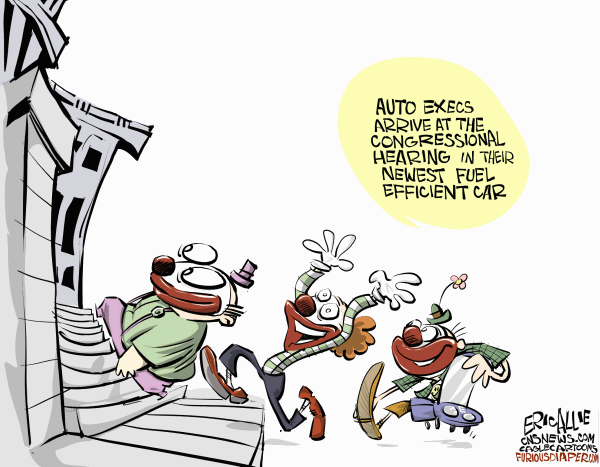
To bailout the big three automakers or not to bailout the big three automakers? In this Guest Voice post journalism professor and author Walter Brasch says, as distasteful as it seems, it needs to be done.
Hit me, Congress, One More Time: Bailing Out the Auto Industry
by Walter Brasch
Congress should bend over, dig into the public coffers once again, and give the auto industry everything it wants even though 61 percent of Americans oppose a bailout, according to a CNN/Opinion Research poll.
A couple of weeks ago, CEOs from GM, Ford, and Chrysler, known collectively as the Big 3, revved up their corporate jets’ engines, dropped in on the Senate, and testified that without a $25 billion bailout western civilization would collapse.
With the nation in a Recession, auto sales have declined to the lowest point since January 1982. Sales are off 47 percent for Ford, 41 percent for GM, and 31 percent for Chrysler from last year. Even sales of major overseas auto manufacturers selling to the American market are down, but not as much as for the Big 3. But, Big 3 market share has plummeted from 70 percent in 1998 to only 53 percent this year, according to Autodata Corp. Equally as important, Consumer Reports has consistently given cars produced by foreign-owned manufacturers higher ratings than American-made cars, although the problem is more attributable to management decisions than problems on the manufacturing line. But, even if Big 3 Management was flawless in their business plans, sales would still be significantly down because of the Recession, partially caused by the sub-prime loan fiasco and the reality that credit is now tight for most Americans.
Congress, which freely handed out more than $700 billion in taxpayer money to financial institutions with fewer morals than the average street walker, now demanded the Big 3 to return with an actual plan. As an afterthought, Congress suggested that the next time executives from GM, Ford, and Chrysler come to the nation’s capital, conspicuous consumption would be frowned up.
As compliant as any corporate “yes man,” the three executives returned, each of them driving a gas-efficient American-built car. Executives from GM and Ford said they planned to sell their jets; Chrysler, owned by Cerberus, a private equity firm, was moot on the issue. Of course, the Big 3 executives should have driven to D.C. the first time, but that’s an issue that six-figure PR executives should have foreseen.
This time, having been properly chastised, the auto execs brought a new proposal to Congress. Instead of a $25 billion bailout, the cost would be $34 billion for loans and credit lines. Apparently, driving a hybrid and eating at roadside diners costs more. And, each of the executives would work for $1 a year. That’s right. The executives who stripped eight-figure income each year from the Big 3 would take a $1 a year token payment if the bailout was dropped into their piggybanks. Naturally, it would be unfair to force myriad 6- and 7-figure income executives below them to sacrifice the family mansion, vacation homes, spa and country club memberships, luxury cars, and private school tuition for their darling upcoming junior executives.
And then the CEOs actually talked.
Would they take less money? Perhaps a $14?15 billion “bridge loan” proposed by Democratic leaders and President Bush would get them through the first quarter of 2009, they said, trying to salvage anything. Would they be willing to increase their contracts with American-owned suppliers while decreasing dependence upon foreign-owned suppliers? Their response was as clear as any Bush statement; translated, they said they might possibly consider that request, as long as the stars aligned correctly during the vernal equinox or some such logic.
Congress has allowed itself to be blackmailed so many times already by banks, investment firms, and an insurance agency that it is hypocritical to bully the auto industry CEOs, and to deny funds to an industry that actually produces a tangible product that is important to all Americans. More important, their product still accounts for a significant part of the workforce.
The national unemployment rate is 6.7 percent, highest in 15 years; the rate is expected to hit about 8 percent in 2009, according to the Wall Street Journal. More significant, if the number of Americans who have been so discouraged by the employment possibilities and are no longer actively looking for full-time work is figured, the percentage rises to about 12.5, according to the Bureau of Labor Statistics. Of about 1.9 million layoffs this year alone, the Big 3 laid off about 140,000, with significantly more anticipated.
Higher unemployment leads to higher housing foreclosures and bankruptcies. It leads not only to depression but also to more health problems, including malnourishment, as Americans cut back on food and medical care. About 46 million Americans don’t have health insurance; millions more who do have insurance provided through their employment can’t afford to get adequate medical care because they can’t afford the deductibles and co-pays.
Corporate America, instead of looking at their own excesses and incompetence, blames workers for the problem. But, the line worker is the one who builds something to the specifications of others but has no input into the decisions that cost the Big 3 their share of the market. For its part, the unions, blamed by almost every executive in America, has gone beyond what should be expected of a union.
The United Auto Workers, which extended major concessions to Chrysler in 1979, agreed to significant concessions in the 2007 contract, including allowing the Big 3 to hire manufacturing line workers at $14?16 an hour, about half of the current employee wages. By any standard, the workers have made far more concessions to keep the auto industry putting along than have the companies themselves.
Nevertheless, a failure by any of the Big 3 would have a severe effect upon several thousand other businesses, including car haulers, suppliers, garages, and dealers. Even the media have been adversely affected. Auto manufacturers are among the leading advertisers in magazines; auto dealers are among the leading advertisers in local daily newspapers. Newspaper advertising is down about 19 percent from last year, according to the Newspaper Association of America; magazine advertising pages are down about 9.5 percent, according to the Publishers Information Bureau. Significant drops in advertising by the Big 3 have contributed to even more media layoffs, including reduced income for all major suppliers, including printers.
Last year, according to data collected by Advertising Age, General Motors, with an advertising budget of $3 billion, was the fourth largest advertiser; Ford, with $2.5 billion, was sixth; Chrysler, with $1.8 billion was thirteenth. However, all three have cut their budgets, with GM eliminating all TV advertising from the Emmys, Academy Awards, and the SuperBowl, and reducing ad spending for all NFL games. GM won’t disclose how much it spent on the Emmys and Academy Awards, but TNS Media Intelligence estimates GM spent $13.5 million just for Oscar night telecast advertising; SuperBowl ads went for about $2.7 million per 30 second spot in 2008; GM had one ad, promoting an SUV hybrid. Although overall TV ad revenue is up from last year, part of that is because of significant spending during the presidential campaign. Lower ad revenue from the automakers and numerous other industries in 2009 will affect programming and the workforce.
With increased unemployment, housing foreclosures, bankruptcies, and lack of adequate health care rising to record levels, a bailout for the Big 3, as distasteful as it seems, is probably the best way to help keep this year-long Recession from going into a Depression. After throwing money at Wall Street, it is far too late for Congress to claim it is looking out for the fiscal interests of the taxpayers, and time to acknowledge that it needs to look after the interests of the workers.
Dr. Brasch is the author of the recently-published Sinking the Ship of State: The Presidency of George W. Bush. He is professor of journalism at Bloomsburg University.
Cartoon by Eric Allie, Caglecartoons.com

Joe Gandelman is a former fulltime journalist who freelanced in India, Spain, Bangladesh and Cypress writing for publications such as the Christian Science Monitor and Newsweek. He also did radio reports from Madrid for NPR’s All Things Considered. He has worked on two U.S. newspapers and quit the news biz in 1990 to go into entertainment. He also has written for The Week and several online publications, did a column for Cagle Cartoons Syndicate and has appeared on CNN.