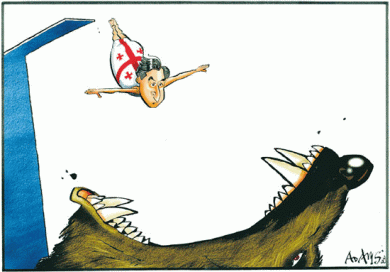
So how did the crisis in Georgia really come about? Many Europeans believe that the events of the past week can be traced back to the recognition of Kosovo – which was also a clear violation of international law – and which the Russians have skillfully turned to their own advatage.
For France’s Le Figaro newspaper, Renaud Girard writes in part:
“Twenty years after being eclipsed by what was called the American ‘hyper power,’ we are witnessing the Russian Bear’s big comeback to the international scene. The Western diplomatic ballet now trying to temper the violence of the Russian reaction to Georgian President Saakachvili’s forceful blow against Southern Ossetia last Thursday will change nothing. … Naively, Saakachvili believed that having international law on his side was enough to enable him to use force. The problem is that his Western friends have just precisely violated these very rules, by unilaterally recognizing Kosovo’s independence … In Brussels earlier this year, Russian Foreign minister Lavrov solemnly warned his American counterpart Condi Rice: the recognition of Kosovo would set a precedent for Abkhazia and South Ossetia. The Americans and their major European allies were mistaken not take him seriously.”
By Renaud Girard
Translated By Nicolas Dagher
August 12, 2008
France – French – Original Article (French)
Twenty years after being eclipsed by what was called the American “hyper power,” we are seeing the big comeback of the Russian Bear to the international scene. The Western diplomatic ballet now trying to temper the violence of the Russian reaction to Georgian President Saakachvili’s forceful blow against Southern Ossetia last Thursday will change nothing. As Vladimir Putin clearly hinted, Georgia seems to have definitively lost its rebel provinces of Ossetia and Abkhazia.
When the Soviet Union disintegrated in 1991 and Georgia obtained its independence, the tiny autonomous region of South Ossetia (72,000 inhabitants), which wished to remain under Moscow’s authority, immediately rebelled against the new central government in Tbilisi. Under communism, no one ever took the delineation of internal borders seriously. The problem is that both in the Soviet Union and Yugoslavia, they remained in force when practically at the same time, the communist federal systems collapsed.
The Ossetians, who speak a language similar to Persian, never felt close to the Georgians, whose language is Caucasian. In 1921, the Ossetians sided with the Bolsheviks against the Georgian separatists. Many Ossetian villages were burned by Georgian secessionists before the Red Army finally got the upper hand. In his policy on nationalities, Joseph Stalin, although of Georgian origin, was always more Russian than the Russians themselves.
READ ON AT WORLDMEETS.US, along with continung translated and untranslated foreign press coverage of the unfolding crisis in the Caucasus as it impinges on our nation.