









Republican presumptive Presidential nominee Senator John McCain is now riding high in the polls and in his cross-country image building trip: he can watch the two Democratic Presidential wannabes bloody themselves (and their party) up. But he faces a ticking time bomb in November: he’s running a campaign deferential to President George Bush when polls and historian rankings show Bush to be one of the most poorly-ranked in American history.
Bush’s poll numbers aren’t the lowest in history (yet) but he is so far down that he can see a sign that says SOUTH POLE and he needs to be careful of relief-seeking sniffing dogs.
Even worse worse in terms of the long view and his legacy, just look at this historians’ poll:
A Pew Research Center poll released last week found that the share of the American public that approves of President George W. Bush has dropped to a new low of 28 percent.
An unscientific poll of professional historians completed the same week produced results far worse for a president clinging to the hope that history will someday take a kinder view of his presidency than does contemporary public opinion.
In an informal survey of 109 professional historians conducted over a three-week period through the History News Network, 98.2 percent assessed the presidency of Mr. Bush to be a failure while 1.8 percent classified it as a success.
Can it get yet worse? Yes:
Asked to rank the presidency of George W. Bush in comparison to those of the other 41 American presidents, more than 61 percent of the historians concluded that the current presidency is the worst in the nation’s history. Another 35 percent of the historians surveyed rated the Bush presidency in the 31st to 41st category, while only four of the 109 respondents ranked the current presidency as even among the top two-thirds of American administrations.

And there’s more:
At least two of those who ranked the current president in the 31-41 ranking made it clear that they placed him next-to-last, with only James Buchanan, in their view, being worse. “He is easily one of the 10-worst of all time and—if the magnitude of the challenges and opportunities matter—then probably in the bottom five, alongside Buchanan, Johnson, Fillmore, and Pierce,” wrote another historian.
In other words: it now appears that there is finally a President of the late 20th to early 21st century who is being ranked as a worse President than the hapless Democratic President Jimmy Carter.
Millsaps College’s Robert S. McElvaine who conducted this poll for the History News Network notes some of the polls weaknesses: historians were “self-selected” but the survey was open to all historians, some believe it is still too early to judge Bush. But he also notes that Bush’s rating has gotten worse — not better — as time goes on. He writes:
Four years ago I rated George W. Bush’s presidency as the second worst, a bit above that of James Buchanan. Now, however, like so many other professional historians, I see the administration of the second Bush as clearly the worst in our history. My reasons are similar to those cited by other historians: In the wake of the terrorist attacks on September 11, 2001, the United States enjoyed enormous support around the world. President Bush squandered that goodwill by taking the country into an unnecessary war of choice and misleading the American people to gain support for that war. And he failed utterly to have a plan to deal with Iraq after the invasion. He further undermined the international reputation of the United States by justifying torture.
Mr. Bush inherited a sizable budget surplus and a thriving economy. By pushing through huge tax cuts for the rich while increasing federal spending at a rapid rate, Bush transformed the surplus into a massive deficit. The tax cuts and other policies accelerated the concentration of wealth and income among the very richest Americans. These policies combined with unwavering opposition to necessary government regulations have produced the worst economic crisis since the Great Depression. Then there is the incredible shrinking dollar, the appointment of incompetent cronies, the totally inexcusable failure to react properly to the disaster of Hurricane Katrina, the blatant disregard for the Constitution—and on and on.
To be sure, there are those who will hail Bush’s actions, say tax cuts have worked and strengthen the economy, defend the idea of a super executive branch with ever-extending powers, hail the Iraq war as necessary when it was launched and necessary now, and blame Katrina on local officials and not the “good job” done by the Bush administration. But those folks are in the 28 percent noted by the Pew poll.
The link contains a slew of other similar comments by historians. Meanwhile, the immediate political danger that McCain and his advisers (which reportedly include Bush political maven Karl Rove) face is this:
Talk to people on the street, you often hear the phrase “one of the worst during my lifetime” or “the worst during my lifetime” (unless they are senior citizens who lived through Herbert Hoover). Do a random sample yourself if you travel, talk to people in stores, business people and young people — and Republicans.
I know of several rock-ribbed Republicans who would love to vote for McCain, but say they won’t because of his stance on the war or because their businesses are decimated and they want a new crew in Washington. At least two will vote for Obama. One won’t vote for anyone since he hates the Democrats, dislikes McCain and feels Bush has been a disappointment and a disaster.
McCain has yet to differentiate himself from Bush. In a sense, he is giving the impression that on the economy and the war voters will get Bush Administration III if they vote for him. Part of the reason is that he is trying to unify his party, win over conservatives and consolidate his partisan base.
Even if the GOP runs an effective and aggressive negative campaign against the Democratic nominee (no matter who he or she is), McCain will be working within the political context of a polity that has generally concluded in polls that the sooner they can get their CEO away from their troubled company, the better.
The historians’ reactions mirror the viewpoints of an increasing number of Americans — American’s who don’t write (or read) weblogs of the left, right or center. These Americans aren’t wealthy talk show hosts who always defend their party, its leader in the White House, and insist there REALLY is no recession out there but only an inconvenient “adjustment” and that most Americans aren’t suffering (and are absolutely convinced of this, as they ride in their private or chartered jets).
In reality, McCain is indeed the strongest candidate the GOP could run this year.
He has an amazing personal narrative, documented courage and charisma that comes across on television. Many independent voters like and trust John McCain, even if they disagree with him on the war.
But then there is a growing consensus by the bulk of Americans, based on polls and similar in many ways to these historians that if this is what a CEO-led government looks like, perhaps its time to quickly shift to a different model with a new leader who can put brand new players in the White House.
FOOTNOTE: All of this lends credence to the notion that the Bush brand is finished for a while. If Jeb Bush — who by many accounts was a highly popular Florida governor — wants to run, probably the earliest he’d be able to do it would be 2016. Perhaps.
Just look at this graph showing George Bush’s approval ratings:

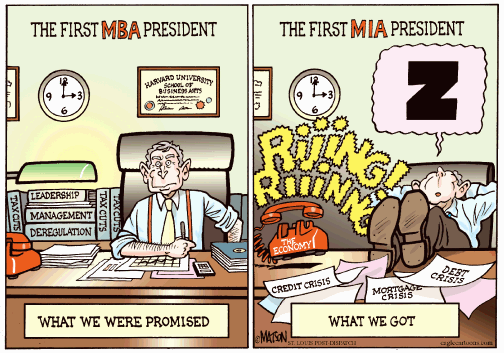
Cartoon by RJ Matson, The St. Louis Post Dispatch
[...] The Moderate Voice – Domestic and international news analysis, irreverent comments, original reporti… wrote an interesting post today on Low Bush Polls And Historical Ranking Negative For McCain Presidential CampaignHere’s a quick excerpt Republican presumptive Presidential nominee Senator John McCain is now riding high in the polls and in his cross-country image building trip: he can watch the two Democratic Presidential wannabies bloody themselves (and their party) up. But he faces a ticking time bomb in November: he’s running a campaign deferential to President George Bush when polls and historian rankings show Bush to be one of the most poorly ranked in American history. Bush’s poll numbers aren’t the lowest in history [...]
[...] The Moderate Voice – Domestic and international news analysis, irreverent comments, original reporti… wrote an interesting post today on Low Bush Polls And Historical Ranking Negative For McCain Presidential CampaignHere’s a quick excerpt Republican presumptive Presidential nominee Senator John McCain is now riding high in the polls and in his cross-country image building trip: he can watch the two Democratic Presidential wannabies bloody themselves (and their party) up. But he faces a ticking time bomb in November: he’s running a campaign deferential to President George Bush when polls and historian rankings show Bush to be one of the most poorly ranked in American history. Bush’s poll numbers aren’t the lowest in history [...]
[...] Low Bush Polls And Historical Ranking Negative For McCain … The Moderate Voice – USA Republican presumptive Presidential nominee Senator John McCain is now riding high in the polls and in his cross-country image building trip: he can watch … See all stories on this topic [...]
[...] [...]
What alarms me the most is that while most people do not like Bush and McCain is all but saying that he will copy Bush's policies exactly, most people do like McCain. And McCain has even said he doesn't understand economics (and that has been made evident by his recent statements on the economy).
I really don't want another four (or eight) years of Bush-like policies… which is what McCain has promised- from his pro-war stance to his ignorance on the concerns of the average American. McCain has shown his willingness to sell himself out to the necessary people in order to win the presidency. If he does become president he'll owe a lot of the current Bushies a whole lot of favors… I just don't want to continue to go down the road where loyalty and cronyism (and calling in favors) are prized above competence in running the government. You'd think the country would have learned this fact and want a different direction after eight tortuous years under Bush… In fact the country overwhelmingly wants a different direction, yet at least half the country is willing to vote for McCain who will just extend the agony brought about by Bush. And then if McCain does have health problems he won't be able to focus on the country's problems. And we know what happens when we have a president that doesn't focus or understand the country's problems…
Hah – 3 A.M. Well played.
Read these excerpts from the respondents to this “informal, non-scientific” survey and draw your own conclusions about the impartial judiciousness of these academics.
“The following are representative examples for each of the presidents named most frequently:
REAGAN: “I think the presidency of George W. Bush has been generally a failure and I consider his presidency so far to have been the most disastrous since that of Ronald Reagan–because of the unconscionable military aggression and spending (especially the Iraq War), the damage done to the welfare of the poor while the corporate rich get richer, and the backwards religious fundamentalism permeating this administration. I strongly disliked and distrusted Reagan and think that George W. is even worse.”
NIXON: “Actually, I think [Bush’s] presidency may exceed the disaster that was Nixon. He has systematically lied to the American public about almost every policy that his administration promotes.” Bush uses “doublespeak” to “dress up policies that condone or aid attacks by polluters and exploiters of the environment . . . with names like the ‘Forest Restoration Act’ (which encourages the cutting down of forests).”
HOOVER: “I would say GW is our worst president since Herbert Hoover. He is moving to bankrupt the federal government on the eve of the retirement of the baby boom generation, and he has brought America’s reputation in the world to its lowest point in the entire history of the United States.”
COOLIDGE: “I think his presidency has been an unmitigated disaster for the environment, for international relations, for health care, and for working Americans. He’s on a par with Coolidge!”
HARDING: “Oil, money and politics again combine in ways not flattering to the integrity of the office. Both men also have a tendency to mangle the English language yet get their points across to ordinary Americans. [Yet] the comparison does Harding something of a disservice.”
McKINLEY: “Bush is perhaps the first president [since McKinley] to be entirely in the ‘hip pocket’ of big business, engage in major external conquest for reasons other than national security, AND be the puppet of his political handler. McKinley had Mark Hanna; Bush has Karl Rove. No wonder McKinley is Rove’s favorite historical president (precedent?).”
GRANT: “He ranks with U.S. Grant as the worst. His oil interests and Cheney’s corporate Haliburton contracts smack of the same corruption found under Grant.”
“While Grant did serve in the army (more than once), Bush went AWOL from the National Guard. That means that Grant is automatically more honest than Bush, since Grant did not send people into places that he himself consciously avoided. . . . Grant did not attempt to invade another country without a declaration of war; Bush thinks that his powers in this respect are unlimited.”
ANDREW JOHNSON: “I consider his presidency so far to have been the most disastrous since that of Andrew Johnson. It has been a sellout of fundamental democratic (and Republican) principles. There are many examples, but the most recent would be his successful efforts to insert provisions in spending bills which directly controvert measures voted down by both houses of Congress.”
BUCHANAN: “Buchanan can be said to have made the Civil War inevitable or to have made the war last longer by his pusillanimity or, possibly, treason.” “Buchanan allowed a war to evolve, but that war addressed a real set of national issues. Mr. Bush started a war . . . for what reason?”
EVER: The second most common response from historians, trailing only Nixon, was that the current presidency is the worst in American history. A few examples will serve to provide the flavor of such condemnations. “Although previous presidents have led the nation into ill-advised wars, no predecessor managed to turn America into an unprovoked aggressor. No predecessor so thoroughly managed to confirm the impressions of those who already hated America. No predecessor so effectively convinced such a wide range of world opinion that America is an imperialist threat to world peace. I don 't think that you can do much worse than that.”
“Bush is horrendous; there is no comparison with previous presidents, most of whom have been bad.”
“He is blatantly a puppet for corporate interests, who care only about their own greed and have no sense of civic responsibility or community service. He lies, constantly and often, seemingly without control, and he lied about his invasion into a sovereign country, again for corporate interests; many people have died and been maimed, and that has been lied about too. He grandstands and mugs in a shameful manner, befitting a snake oil salesman, not a statesman. He does not think, process, or speak well, and is emotionally immature due to, among other things, his lack of recovery from substance abuse. The term is “dry drunk”. He is an abject embarrassment/pariah overseas; the rest of the world hates him . . . . . He is, by far, the most irresponsible, unethical, inexcusable occupant of our formerly highest office in the land that there has ever been.”
“George W. Bush's presidency is the pernicious enemy of American freedom, compassion, and community; of world peace; and of life itself as it has evolved for millennia on large sections of the planet. The worst president ever? Let history judge him.
My own answer to the question was based on astonishment that so many people still support a president who has:
* Presided over the loss of approximately three million American jobs in his first two-and-a-half years in office, the worst record since Herbert Hoover.
* Overseen an economy in which the stock market suffered its worst decline in the first two years of any administration since Hoover’s.
* Taken, in the wake of the terrorist attacks two years ago, the greatest worldwide outpouring of goodwill the United States has enjoyed at least since World War II and squandered it by insisting on pursuing a foolish go-it-almost-alone invasion of Iraq, thereby transforming almost universal support for the United States into worldwide condemnation. (One historian made this point particularly well: “After inadvertently gaining the sympathies of the world 's citizens when terrorists attacked New York and Washington, Bush has deliberately turned the country into the most hated in the world by a policy of breaking all major international agreements, declaring it our right to invade any country that we wish, proving that he’ll manipulate facts to justify anything he wishes to do, and bull-headedly charging into a quagmire.”)
* Misled (to use the most charitable word and interpretation) the American public about weapons of mass destruction and supposed ties to Al Qaeda in Iraq and so into a war that has plainly (and entirely predictably) made us less secure, caused a boom in the recruitment of terrorists, is killing American military personnel needlessly, and is threatening to suck up all our available military forces and be a bottomless pit for the money of American taxpayers for years to come.
* Failed to follow through in Afghanistan, where the Taliban and Al Qaeda are regrouping, once more increasing the threat to our people.
* Insulted and ridiculed other nations and international organizations and now has to go, hat in hand, to those nations and organizations begging for their assistance.
* Completely miscalculated or failed to plan for the personnel and monetary needs in Iraq after the war, so that he sought and obtained an $87 billion appropriation for Iraq, a sizable chunk of which is going, without competitive bidding to Haliburton, the company formerly headed by his vice president.
* Inherited an annual federal budget surplus of $230 billion and transformed it into a $500+ billion deficit in less than three years. This negative turnaround of three-quarters of a trillion dollars is totally without precedent in our history. The ballooning deficit for fiscal 2004 is rapidly approaching twice the dollar size of the previous record deficit, $290 billion, set in 1992, the last year of the administration of President Bush’s father and, at almost 5 percent of GDP, is closing in on the percentage record set by Ronald Reagan in 1986.
* Cut taxes three times, sharply reducing the burden on the rich, reclassified money obtained through stock ownership as more deserving than money earned through work. The idea that dividend income should not be taxed—what might accurately be termed the unearned income tax credit—can be stated succinctly: “If you had to work for your money, we’ll tax it; if you didn’t have to work for it, you can keep it all.”
* Severely curtailed the very American freedoms that our military people are supposed to be fighting to defend. (“The Patriot Act,” one of the historians noted, “is the worst since the Alien and Sedition Acts under John Adams.”)
* Called upon American armed service people, including Reserve forces, to sacrifice for ever-lengthening tours of duty in a hostile and dangerous environment while he rewards the rich at home with lower taxes and legislative giveaways and gives lucrative no-bid contracts to American corporations linked with the administration.
* Given an opportunity to begin to change the consumption-oriented values of the nation after September 11, 2001, when people were prepared to make a sacrifice for the common good, called instead of Americans to ‘sacrifice’ by going out and buying things.
* Proclaimed himself to be a conservative while maintaining that big government should be able to run roughshod over the Bill of Rights, and that the government must have all sorts of secrets from the people, but the people can be allowed no privacy from the government. (As one of the historians said, “this is not a conservative administration; it is a reckless and arrogant one, beholden to a mix of right-wing ideologues, neo-con fanatics, and social Darwinian elitists.”)
My (Robert S. McElvaine's) assessment is that George W. Bush’s record on running up debt to burden our children is the worst since Ronald Reagan; his record on government surveillance of citizens is the worst since Richard Nixon; his record on foreign-military policy has gotten us into the worst foreign mess we’ve been in since Lyndon Johnson sank us into Vietnam; his economic record is the worst since Herbert Hoover; his record of tax favoritism for the rich is the worst since Calvin Coolidge; his record of trampling on civil liberties is the worst since Woodrow Wilson.
They're called links Weightman
Very handy in preventing 1,718 word comments.
Scroll Wheel
I do agree with Weightman that the tragedy of George W Bush is the fact that he seems to combine the worst attributes of the worst presidents in our history. The realization of this by the majority of Americans has led to his supporters falsely labelling that realization as BDS. In reality, it is just an accurate assessment of his devastating failures in so many areas.
LBJ made tragic mistakes of judgement in Vietnam, but made great strides in civil rights domestically, Nixon was a dishonest , paranoid, partisan who was willing to do anything to win, but established the EPA, and was responsible for detente with the USSR and China. Grant may have been tied in with moneyed interests, but he fought to bring equality to freed blacks in the South. Reagan may have increased inequality, but few doubt that his strong leadership refurbished America's reputation abroad, and led to the end of the Cold War.
W has no redeeming achievements to balance his failures. He will leave office with the economy in recession, the military stretched to the breaking point, the US' reputation abroad in shambles, and the American people divided and mistrustful of their own government. Historians are correct when they say that he and Cheney were in the pocket of big industry, allowing bigwigs to set policy in many arenas.
I wonder if McCain would get the same reception at a baseball game if he copied Bush's policies!
http://beta.flowgram.com/p/OYBJIRAUIOIOV8
It seems the people are ready for a change….
John McCain accused Barack Obama of playing politics with race on Thursday, raising the explosive issue after the first black candidate with a serious chance of winning the White House said Republicans will try to scare voters by saying he “doesn't look like all those other presidents on the dollar bills.” Until now, the subject of race has been almost taboo in the campaign, at least in public, with both sides fearing its destructive force.
============================
Bobwilliams
consumer generated media