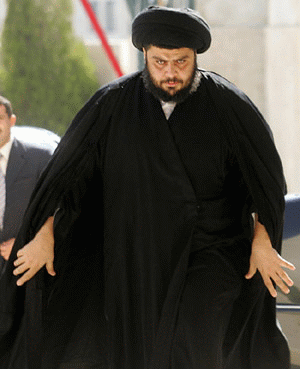
Now that the man once described by the U.S. government and media as ‘radical Shiite cleric’ Muqtada al-Sadr, has extended the truce observed by his Mahdi Army Militia, some are wondering what could be behind his apparent embrace of peace. It may well be that the inter-Shiite violence that was ripping parts of Iraq apart was not to Iran’s liking. Elias Harfouche of Lebanon’s Dar al-Hayat writes, ‘After the announcement of the first truce last year, it was said that al-Sadr headed to the Iranian city of Qum to seek protection from Iran’s leadership, fearing for his safety in Iraq. It’s more likely that the Iranian project in Iraq, like the rest of its projects in the region, leaves very little room for sectarian divisions of the type that seemed to be developing in Iraq. This may explain al-Sadr’s “awakening” and his belatedly seeing reason!
By Elias Harfouche
February 24, 2008
Lebanon – Dar al-Hayat – Original Article – (English)
Who would have imagined at the beginning of the American invasion of Iraq five years ago, that the decisions of Muqtada al-Sadr and the Al-Mahdi Army he leads would be the subject of praise by American forces, which once described him as “the most dangerous man in Iraq?” Indeed who would have imagined that this young leader, once held responsible for the bloodiest sectarian aggressions, would be transformed into the Shiite figure embodying the hope of preventing sectarian disintegration?
The Mahdi Army was among the leading forces confronting the Americans in Iraq. These confrontations, however, turned into a confessional war against Sunnis in Baghdad and elsewhere. It wasn’t long before Sunni groups began to respond in kind with “cleansings” that encompassed Shiite areas. After all, it is well-known that sectarian war begets more sectarian war.
Thus, expulsion became a “national” trend that included all sides. The struggle then shifted to the Shiite sect itself, and took the form of a struggle between followers of al-Sadr and the Supreme Islamic Council led by Abd al-Aziz al-Hakim. Last summer’s Karbala War between the factions was the turning point that induced Muqtada al-Sadr, who ordered to control the undisciplined elements of his army by top Shiite cleric Sayyid Ali Sistani.
From the other side of this divide, the inter-Sunni struggle was also expanding. While the confrontation had once focused on American forces, inside what was once known as the “Sunni triangle” from Baghdad to the governates of Anbar and Salah al-Din, the killings began to claim Iraqis in a war of leaderships and clan struggle, which demonstrated the difficulty of creating cohesion in this region in terms of tribal solidarity and allegiance. But these internal struggles facilitated the American penetration of the region, especially with the emergence of the Councils of Awakening, America’s most important accomplishment in their war against Iraqi resistance factions wearing the Sunni cloak.
One could describe Muqtada al-Sadr’s decision as a kind of awakening similar to the Sunni awakening. In the letter that was read in his name at mosques following Friday prayers last week, Al-Sadr acknowledged his awakening to the poor morale in his army and the importance of preventing disputes among Iraqis.
READ ON AT WORLDMEETS.US, along with continuing coverage of the Iraq War from an Arab perspective.