















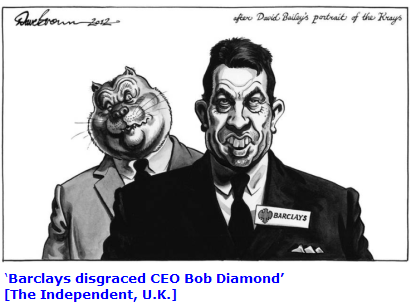
For most of us, a billion dollars is hard to fathom, let alone a trillion. But the newest scandal now breaking across the world entails a figure so great, we may soon be talking in quadrillions – which is the next order of magnitude after trillion. According to columnist Till Schwarze of Germany’s Die Zeit, the manipulation by the world’s largest banks of the LIBOR – London Interbank Offered Rate – may finally drive reforms that banks avoided in 2008, when $65 trillion in private equity is thought to have been wiped out.
For Die Zeit, Till Schwarze writes in part:
The British financial sector has its next scandal, but it almost certainly will not be confined to the island. For years, regulatory authorities in the U.S., Great Britain, Switzerland as well as the E.U., have been investigating more than a dozen major banks around the world on suspicion of manipulating the key interest rates LIBOR [London Interbank Offered Rate] and EURIBOR. Included are heavyweights like Deutsche Bank, UBS, Citigroup, HSBC and Lloyds.
The allegations at issue relate to financial transactions with a volume of more than $350 trillion (€280 trillion ): the banks allegedly manipulated the interest rates of interbank loans in order to boost their own profits and conceal the true cost of refinancing those loans.
To understand how such a manipulation might work, one must grasp the significance of LIBOR and EURIBOR in the financial industry. The LIBOR determines how much banks have to pay to borrow money from one another. In addition, it is also the benchmark for many other financial transactions. For example, it serves as the basis for corporate loans and for trade in derivatives and other financial products. A number of central banks also use base their monetary policies on LIBOR. And what the LIBOR is for the dollar currency area, the pound or the yen, the EURIBOR is for the euro zone.
The impact of these key interest rates on the financial industry is therefore considerable and, as the LIBOR and EURIBOR are determined by information provided by the most important banks, the possibilities for manipulation are correspondingly large. Banks report the interest rates other banks are required to pay for loans to the Thomson Reuters agency, which in turn uses those figures to calculate the LIBOR. The reporting of interest rates is highly confidential and based solely on information provided by each bank, and it is very difficult to verify the accuracy of the reported figures.
READ ON IN ENGLISH OR GERMAN AT WORLDMEETS.US, your most trusted translator and aggregator of foreign news and views about our nation.