
















NOTE: The Moderate Voice runs Guest Voice posts from time to time by readers who don’t have their own websites, or people who have websites but would like to post something for TMV’s diverse and thoughtful readership. Guest Voice posts do not necessarily reflect the opinions of The Moderate Voice or its writers. This Guest Voice is by J. Thomas Andrews, who lives in the Northeast. He writes that he works in venture capital and specializes in energy and natural resources.
Oil Shale to the Rescue?
By J. Thomas Andrews
Let me start by saying that this post is as non-partisan as it gets. I care about America, not political parties. So buckle your seatbelt…
We’re facing an oil crisis. Biofuels and hybrids will not save us in time. But oil shale might.
Let’s start with some hard facts.
America’s domestic petroleum production is in decline. In 2000, America’s domestic oil production was 5.8 million barrels/day. In 2005, even though prices had skyrocketed—a stimulant for production growth— domestic oil production was only 5.2 million barrels/day. In America, oil no longer gushes to the surface like it once did. The days of Spindletop are long over. To make matters worse, petroleum production in many oil exporting countries outside of the Persian Gulf, such as Norway, is also in decline. The only region with significant untapped reserves of conventional oil is the Persian Gulf. That said, America will come to depend on the Persian Gulf for more and more of its crude in the coming years unless things change dramatically.
So will the rest of the world. Global demand for petroleum is surging while the world’s crude supply is being concentrated in the hands of Iran, Saudi Arabia, the UAE, Iraq, and Kuwait, and Bahrain. This is the ultimate recipe for conflict and the greatest threat to America’s economic security.
In recent years, many people, including our policymakers, have come to believe that biofuels will save us from Persian Gulf petroleum dependence.
“Ramp up the availability of ethanol,” Hillary Clinton recently commanded.
“We’ve got to get serious about ethanol,” according to Rudy Giuliani.
Many politicians—often the same ones who support biofuels—also support hybrids.
Mitt Romney, whose father was a Detroit auto executive, announced his candidacy while standing in front of a hybrid Ford SUV. Tom Tancredo says he drives a hybrid. So does John Edwards.
But the difficult truth is that neither biofuels nor hybrids will reduce our dependence on Persian Gulf crude anytime soon.
Today, biofuels are not cost-competitive with conventional crude. They only survive with subsidies. Moreover, the potential for biofuels to contribute to our energy recipe is severely limited by their land requirements. Right now, ethanol is produced primarily from corn. According to a 2006 University of Minnesota study, dedicating the entire U.S. corn crop to ethanol production could only offset 12% of our gasoline consumption. According to researchers at the Cato Institute, “For corn ethanol to completely displace gasoline consumption in this country, we would need to appropriate all U.S. cropland, turn it completely over to corn-ethanol production, and then find 20 percent more land for cultivation on top of that.â€
Perhaps, in the future, more advanced cellulosic ethanol technologies will mature to a point where they will be cost competitive with gasoline. Perhaps then, switchgrass and miscanthus, which have much higher yields than corn, will become the dominant biofuel feedstocks. When that happens, perhaps, as Bruce E. Dale of Michigan State University speculates, under the most optimistic case scenario, the United States could replace 85% of its current gasoline consumption by converting 100 million acres of land to cellulose production. But, cellulosic ethanol technologies are years away from technological and commercial viability. And it will take decades more before America allocates 100 million acres of land—an amount roughly equivalent to ¼ of America’s harvested cropland—to cellulose production.
And, keep in mind that this is an optimistic projection.
According to an article in the Nov-Dec 2006 edition Harvard Magazine by Harvard environmental scientist Michael McElroy, to supplant just 50 percent of America’s current gasoline use with cellulosic ethanol could require as much as 280 million acres of land. As McElroy points out in a supplemental technical discussion of his article, that’s roughly equal to 75 percent of the cropland currently in use or 49 percent of America’s grassland, pasture, and range. Regardless of whose forecast is more accurate—Dr. Dale’s or Dr. McElroy’s—we can be sure that it would take years before enough land could be allocated for cellulosic ethanol production to power any significant percentage of our cars. Can we afford to wait that long?
If you think hybrids will soon serve as our lifeboats out of this mess, you’re wrong. Hybrids will not penetrate the U.S. market in large quantities anytime soon. Consider that the median lifetime of an American automobile is 17 years. According to the Bureau of Transportation Statistics, there were 136.6 million passenger cars on America’s roads in 2005, the most recent year for which data has been published. In 2005, though, there were only 7.6 million new car sales and leases in the United States. In other words, new cars make up only 5.6% of cars on the road every year. Even if hybrids were to make up 100% of new cars sold starting tomorrow, it would take a generation before they would replace the entire U.S. fleet. That’s the most optimistic, and totally unrealistic, scenario. In light of Detroit’s resistance thus far to hybrid development, we can be sure that it will take years before hybrids make up any significant fraction of new cars sold, and it will be a generation before hybrids replace our entire fleet. I don’t want to wait that long for energy security.
The only real option America has if it hopes to free itself from the shackles of Middle East petro-politics anytime soon is to find new sources of domestic petroleum. Am I suggesting that we drill ANWR? The truth is that it doesn’t make much of a difference if we do or don’t. ANWR is a red herring—it only has enough petroleum to support America’s domestic needs for just one year—maybe two. However, we have another source of domestic petroleum that has the potential to make a big difference: oil shale.
Oil shale is a type of rock that has a petroleum precursor called kerogen trapped inside of it. Using a variety of mechanical and chemical processes, this kergoen can be extracted and upgraded into liquid fuels like synthetic gasoline and synthetic diesel. The United States has the largest oil shale resources in the world. Most of America’s oil shale deposits are located in the undeveloped Green River Formation, which straddles Colorado, Wyoming, and Utah. According to the Rand Corporation, as much as 1.1 trillion—yes, trillion— barrels of synthetic petroleum could be recovered from the Green River Formation. According to the U.S. Department of Energy, that is four times the size of Saudi Arabia’s proved reserves of conventional oil, and approximately equal to all of the proved reserves of conventional oil on earth!
Oil shale has received little attention in recent decades, but some Americans probably remember hearing about the resource during the Arab oil embargoes. In 1980, at the height of the embargoes, the U.S. Congress created the Synthetic Fuels Corporation, which was, in part, intended to develop America’s oil shale industry. When the Synthetic Fuels Corporation was created it was incredibly expensive to squeeze petroleum out of oil shale, and the plan was to invest in research and development to pioneer cheaper methods to produce shale oil. House Majority Leader, Rep. Jim Wright of Texas, thought so highly of the bill that created the Synthetic Fuels Corporation that he described it as “the most important bill we’ll act on during this decade, beginning an initiative we should have started in the 1950s.†However, by 1985, after the Arab embargoes ended and the price of oil plummeted, the incentive to invest in oil shale plummeted as well. Nearly every oil shale project in America was abandoned. With conventional oil selling at less than $25/Bbl, why would anyone want to invest in oil shale, which looked like it would never break the $80/Bbl profitability threshold?
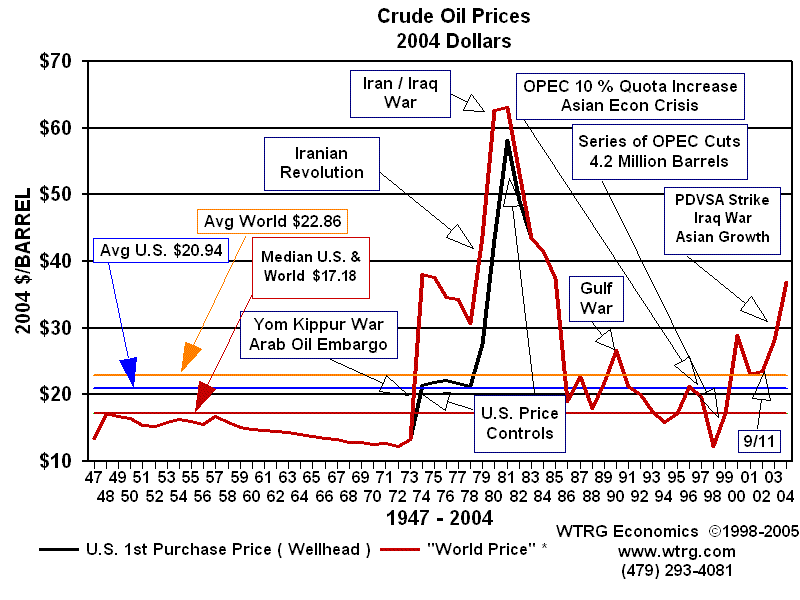
Over the past few years though, a few things have changed. First, the price of oil has again skyrocketed. And, unlike in the 1980s, the price of oil does not look like it will come down again. This is because the peak in global production is fast approaching while demand is surging: limited supply and higher demand can only mean higher prices. Moreover, the Persian Gulf oil powers will likely continue to inflate oil prices as their stranglehold over the petroleum market tightens. As a 2005 Citigroup report noted, “…the days of $25 oil are long gone and unlikely to return any time soon.†Governments and businesses around the world are now forecasting long-term oil prices above $40, $50, and even $60 a barrel. These could all be conservative estimates.
The second major change relevant to oil shale is that several companies operating under the radar screen have developed radically cheaper oil shale production methods over the past few years. Shell is confident that a new technology it is pioneering could produce shale oil profitably if the price of crude settles above ~$25/Bbl. According to a 2006 report in BusinessWeek, an Israeli company may now be able to produce shale oil at a cost of $17/Bbl. And, according to a 2004 DOE report, an Estonian firm believes that it can produce shale oil profitably with crude prices as low as $13/Bbl.
Assuming that these figures are remotely accurate, shale oil now appears to be significantly cheaper than conventional crude. In addition, it appears to be significantly cheaper than any biofuel or coal-to-liquids solution. For the first time in history, America’s vast oil shale resources are economically viable.
Will the price of conventional crude plummet again, undermining the economic viability of oil shale, as it did in the early 1980s? Maybe, but probably not. Because the cost of producing shale oil using these newly developed oil shale technologies is so low, it is highly unlikely that the Persian Gulf producers could lower global prices enough to sabotage a domestic oil shale industry. And even if the Persian Gulf suppliers could, they may not want to—with India and China industrializing so quickly, there will be plenty of demand for conventional Persian Gulf petroleum even if the U.S. reduces its oil imports from the Middle East. Consider that more than 80% of Saudi Arabia’s oil exports are already sent to countries other than the United States.
The benefits of a new domestic oil shale industry could be enormous.
According to Senate testimony by Milton R. Copulos, the president of the National Defense Council Foundation, the United States spent $251 billion on foreign crude 2005. In 2006, we spent even more—perhaps $320 billion. These figures only include the actual cost of purchasing the oil—they do not include externalities such as the military cost of defending our supply of Persian Gulf crude. But, even without these externalities—which themselves are in the many tens of billions of dollars—the amounts are staggering. According to the U.S. Department of Labor, $320 billion dollars is more money than the annual salaries of every elementary & secondary school teacher, physicist, chemist, economist, internist, pediatrician, registered nurse, veterinarian, firefighter, librarian, astronomer, epidemiologist, psychiatrist, and microbiologist in the United States combined!
Promoting the development of an American oil shale industry would help keep this money in the hands of Americans and out of the hands of anti-American-terrorist-recruiting-Saudi-funded mullahs. Moreover, it would stimulate massive job growth in America, increase tax revenue that could be used to reduce the deficit, improve our schools, and fund medical research. Imagine the diseases we could cure with $320 billion dollars. We could double the number of teachers in our schools and still have billions and billions of dollars left over.
The primary objection to oil shale development relates to greenhouse gasses. Indeed, a large-scale U.S. oil shale industry would increase America’s greenhouse gas emissions. But not by a significant amount.
According to recent research done by Adam Brandt, a Ph.D. candidate at Berkeley, the full-fuel-cycle emissions— including emissions from processing, refining, and combustion— associated with oil shale production using the Alberta Taciuk Process, which may cost as low as low as $13/Bbl, “are 50-60% higher on a full-fuel-cycle basis than those from conventional oil production.†Also, according to Brandt, the full-fuel-cycle carbon emissions associated with Shell’s newest oil shale process, known as the in situ process, which is the same process that Shell claims is profitable when crude is above ~$25/Bbl, “are roughly 10% to 50% larger than those from conventionally produced petroleum-based fuels.†These number may sound big, but when put in a global context, they’re not.
Consider this: if America were to replace all of the gasoline it derives from Persian Gulf crude with domestically produced shale oil, worldwide carbon emissions would only increase by approximately 0.2%, even if we use Brandt’s highest estimate for carbon emissions associated with oil shale production. Even if we double Brandt’s high-end carbon estimates and assume that gasoline produced from shale oil results in carbon emissions that are 120% higher than conventional crude oil production and combustion, the resulting emissions increase is still insignificant: 0.4%.
Do we really want to keep asking young Americans to sacrifice their lives on military operations in the Middle East so that we can keep global carbon emissions down 0.4%? I certainly hope not.
If you’re still concerned about such an increase in carbon emissions from a domestic oil shale industry, remember that China alone is increasing global CO2 emissions at a rate between 2-3% every year. Any limitations we put on our carbon emissions will be undermined by China as long as the Chinese continue to build two dirty coal power plants every week. Let’s keep things in perspective.
Finally, keep in mind that the tax revenue that would be generated by a domestic oil shale industry could be invested in greenhouse-gas fighting technologies such as carbon sequestration. Such technologies could reduce global greenhouse gas emissions by amounts far in excess of the tiny increase that may come as a result of the creation of an American oil shale industry.
I am an optimist and I hope that hybrids and biofuels will one day make a huge difference. But we need to accept that we will be dependent on petroleum for quite some time and adjust our policies accordingly. Oil shale may hold the most promise.
The vast majority of America’s oil shale is on federal land (at the start of the last century, our policy makers wisely realized that oil shale could be used to provide transportation fuels, so they cordoned off the largest deposits to save them for later use!). We need to adopt a regulatory atmosphere that allows, and, in fact, promotes, the commercial development of our oil shale resources. The sooner we do so, the better.
“We will break the back of the energy crisis; we will lay the foundation for our future capacity to meet America’s energy needs from America’s own resources,†said President Nixon in his 1974 State of the Union. “We must end vulnerability to economic disruption by foreign suppliers,†said President Ford in his 1975 State of the Union. “Our excessive dependence on foreign oil is a clear and present danger to our Nation’s security,†said President Carter in his 1980 State of the Union Address. Reagan, Bush I, Clinton, and Dubya have all also chimed in with a similar refrain. Indeed, the majority of the State of the Union addresses since the 1973 oil embargo have contained calls for increased American energy independence. “The result?†as Charles Krauthammer noted in a recent Washington Post opinion piece: “In 1973 we imported 34.8 percent of our oil. Today we import 60.3 percent.†But, now, thanks to oil shale, we can at last turn all of this rhetoric into reality.

Joe Gandelman is a former fulltime journalist who freelanced in India, Spain, Bangladesh and Cypress writing for publications such as the Christian Science Monitor and Newsweek. He also did radio reports from Madrid for NPR’s All Things Considered. He has worked on two U.S. newspapers and quit the news biz in 1990 to go into entertainment. He also has written for The Week and several online publications, did a column for Cagle Cartoons Syndicate and has appeared on CNN.