














Since Vice President Dick Cheney is insisting his office isn’t part of the executive branch, the Democrats have decided to take legislative action to take away its executive branch funding.
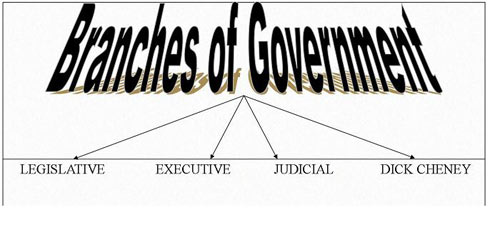
And Democratic Caucus Chairman Rep. Rahm Emanuel (D-Ill) has also released a graphic that shows the “new” set up of the United States government with its newest self-declared branch. SEE EMANUEL’S GRAPHIC ABOVE.
As we said earlier, this story is not over yet:
Following Vice President Dick Cheney’s assertion that his office is not a part of the executive branch of the US government, Democratic Caucus Chairman Rep. Rahm Emanuel (D-IL) plans to introduce an amendment to the the Financial Services and General Government Appropriations bill to cut funding for Cheney’s office.
The amendment to the bill that sets the funding for the executive branch will be considered next week in the House of Representatives.
“The Vice President has a choice to make. If he believes his legal case, his office has no business being funded as part of the executive branch,” said Emanuel in a statement released to RAW STORY. “However, if he demands executive branch funding he cannot ignore executive branch rules. At the very least, the Vice President should be consistent. This amendment will ensure that the Vice President’s funding is consistent with his legal arguments.”
“Consistent” — what’s that?
See our earlier post HERE.
UPDATE: Prominent conservative blogger Ed Morrissey is following this controversy and doesn’t like what he sees. A small bit of a post that should be read in full:
American culture and identity was formed on the basis that no man is above the law, not even Presidents and Vice-Presidents. If the executive order puts too much burden on the White House, then Bush should revoke or amend it, and explain why it’s necessary to do so. Stop trying to pretend that the VP is a member of the legislature and playing damaging games….
….Arguing that the VP belongs to the legislative branch either looks like desperation or a Constitutional illiteracy that should disturb everyone, not just Democrats.
Glenn Reynolds, Instapundit, also has a long post written by him not just as a blogger but as someone who is also a law professor.
It too should be read in full because quoting it takes it too much out of context. Here part of it:
Whatever executive power a VP exercises is exercised because it’s delegated by the President, not because the VP has it already. So to the extent the President delegates actual power (as opposed to just taking recommendations for action) the VP is exercising executive authority delegated by the President, but unlike everyone else who does so he/she isn’t subject to removal from office by the President (though the President could always withdraw the delegation, of course). However — and here’s where the claim that Cheney is really a legislative official creates problems for the White House — it seems pretty clear that the President isn’t allowed to delegate executive power to a legislative official, as that would be a separation of powers violation. So to the extent that this is what’s going on, the “Cheney is a legislative official” argument is one that opens a big can of worms……..None of this is to say that the President can’t, in his own capacity, decide to apply different rules to the VP (who, after all, is an elected official, unlike cabinet secretaries, NSC staffers, and the like) if he chooses. But that’s a different issue entirely from the “legislative official” angle. Like a lot of the Bush Administration’s arguments, this is one that would make an interesting law school paper topic, or law review article, but that is politically idiotic and legally self-defeating. It’s reminiscent, as one of Capt. Ed’s commenters notes, of the Clinton Administration’s effort to stall Paula Jones’ lawsuit by claiming that as Commander-in-Chief the President is a serving member of the military. Clever, in a way. But definitely not smart.
Read it all.

Joe Gandelman is a former fulltime journalist who freelanced in India, Spain, Bangladesh and Cypress writing for publications such as the Christian Science Monitor and Newsweek. He also did radio reports from Madrid for NPR’s All Things Considered. He has worked on two U.S. newspapers and quit the news biz in 1990 to go into entertainment. He also has written for The Week and several online publications, did a column for Cagle Cartoons Syndicate and has appeared on CNN.