















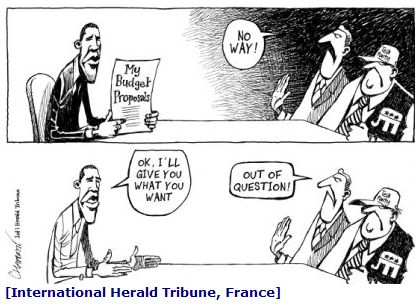
Does the U.S. political crisis demonstrate what Beijing has been saying for years: that it is dangerous for U.S. creditors to allow the dollar to continue as the global currency of choice? According to this article by Li Xiangyang for the state-run People’s Daily, until the dollar is dethroned, holders of U.S. sovereign debt ‘must either endure the enormous immediate financial risk brought about by a U.S. default, or hold additional U.S. debt at their peril.’
For the People’s Daily, Li Xiangyang, director of the Institute of Asia-Pacific Studies at the Chinese Academy of Social Sciences, writes in part:
Foreign holders of U.S. debt confront a serious risk. Because U.S. political parties only consider their own interests and dare to ignore those of foreign creditors, it is very likely that sooner or later, America will harm the interests of foreign creditors for its own political, economic or security interests.
In other words, the U.S. may use the possibility of a debt default to threaten other countries. This is the horrific systematic risk hidden within the current international financial system. The U.S. debt crisis poses a real dilemma for foreign creditors. They must either endure the enormous immediate financial risk brought about by a U.S. debt default, or hold additional U.S. debt at their peril.
At the same time, the U.S. debt crisis serves as a wake-up call to China, the largest foreign holder of U.S. Treasury bonds. China must stop increasing its already massive holdings of foreign exchange reserves and be alert to the national security and national financial risks inherent in excessive U.S. dollar assets.
There is a growing consensus in this post-global financial crisis era that the dollar-centered system of international currency exchange should be reformed as quickly as possible. Getting rid of the dollar will serve not only the interests of creditor countries, but ensure the stability and sustainability of the international financial system.
Getting rid of the dollar will serve not only the interests of creditor countries, but ensure the stability and sustainability of the international financial system.
READ ON AT WORLDMEETS.US, your most trusted translator and aggregator of foreign news and views about our nation.

Yeah, we may indeed default on our obligations for various reasons, but when we do we’ll never sell another bond without paying extraordinarily high interest rates.
Tax and Spend will then have supplanted Borrow and Spend. How ironic.
I see a world currency under a world government somewhere in the future.
“I see a world currency under a world government somewhere in the future.”
That’s a very popular conspiracy theory. If it’s true, the Euro/PIIGS situation should be knocking those plans back a bit.
ProfElwood-
What do you mean by “Euro/PIIGS?
What Conspiracy? Unity?
I thought conspiracies were only valid for dividing people, not uniting them.
The one world government, or new world order is the conspiracy theory that says the the financial elite are trying to take over the world’s currency. The Euro was supposed to the first of one currency per continent, that would eventually be merged into one world currency.
PIIGS is a list of Euro debtor nations: Portugal, Ireland, Italy, Greece (of course), and Spain. These nations are at the point of debt where they would normally fire up the printing presses to pay off their debt (monetizing the debt). Having a group currency prevents them from doing so. Greece has been getting the press, but the rest are in a similar boat.
I’m not sure what effect conspiracy theories have, but I think they’re meant more as comfort food for those who can’t face the fact that corruption and ineptitude are actually quite normal, and need no coordination.
Imagine the desire for inflation that masters of a global currency would have. As if inflated national currencies weren’t “the real opiate of the masses” enough, already!
* * *
Don’t be surprised if in the end, a debt limit increase without anything else is what people rush to do. (Congress willingly should vote on it the same day it’s agreed upon.) It’s a shame that there can’t be not only a good federal budget but true fiscal reform, so very overdue, including in particular entitlement reform. Unfortunately, it’s probably not possible. The GOP is adamant about no new taxes, which really isn’t that bad (despite the nonsense from the Left), but which is stubborn — to get a deal with the Dems means tax increases of some kind. The GOP also is pushing something in itself fine and overdue, a balanced budget amendment, but is clumsy and odd to push for it now. As for the Dems, they remain the real problem, just as spending is our real fiscal problem in Washington, particularly with entitlements. A number of Democrats are mindless, resisting any and all entitlement reforms, while we remain way of just what in fact constitutes any spending “cuts” offered by Obama or by the Congressional Dems. Finally, there’s the motive affecting both parties: the 2012 elections. Neither party wants to do anything that will upset a great number of people, no matter how appropriate or even necessary. (Real reform will be avoided until it cannot be avoided any longer; at that time, politicians will retire.)
ProfElwood-
Oh yeah Prof I get now.
Danke.