














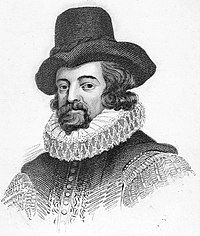
Today’s literary quote of the day is from sir Francis Bacon‘s Of Great Place.
For good thoughts (though God accept them) yet, towards men, are little better than good dreams, except they be put in act; and that cannot be, without power and place, as the vantage, and commanding ground.
Share your thoughts on today’s literary quote in the comment section of this post.
Funny how Bacon uses good works as the fig leaf to cover the nakedness of raw ambition.
The whole essay – if folks read it – reminded me of Shakespeare…but of pretensions that Shakespeare (if sometimes subtly) mocked. Like the echoes of Polonius in lecturing Laertes in Hamlet in the closing advice of how to conduct onself. Or the pitying of the hard lives of great men…seen in the self-pity of Henry V before Agincourt, who admires a poor soldier’s easy life…the irony being that Henry V is about the consuming ambition of one man who would destroy everything to achieve it.
A good quote in our political season…as Hillary et al struggle for the sad, miserable life of service and good works in the White House.
Reading these lines only, and not all of Bacon’s philosophy, I see a reminder here that good intentions have no real value unless they are put into action.
But notice how Bacon shades the meaning here…before the semi-colon there is the bromide about how good thoughts must be made into good acts.
It is after the semi-colon that there is the clincher: “that cannot be, without power and place…and commanding ground.”
I.E. One can only do good acts when one has power and position.
It is because of such devious language in conventional political theory that Machiavelli was both so popular and reviled in the Renaissance. Clear, concise language describing princes and prelates as they were – egotistical and power-hungry above all things, and caring little for good works.
Francis Bacon was a corrupt and nasty piece of work as a courtier. One can easily imagine him at the court of President Hillary – she does actually have a courtier very much like Bacon (can you guess his name?) – writing obsequious bromides about the virtues of his mistress, and doing his mistress’ dirty deeds by darkness.
Marlowecan said about Bacon’s meaning ” ..One can only do good acts when one has power and position…
It’s an illucidating exercise to take lines from a text and interpret them as part of a broad klnowledge about the author. You might very well be right about Bacon’s ambition being refelcted here.
I try to be cautious, because once you start on a broad interpretation, you bring in personal connections in addition to the author’s history. Then, too, it’s impossible to know which of the authors tenets he was thinking of while writing particular lines.
I do NOT necessarity disagree. I’m just more cautious.
There is a parallel, eternal discussion about paintings: Should the painting be allowed to speak for itself, or is it necessary to know about the painter’s life?
If you know nothing about the painter, you might miss what he was attempting to achieve. But if you know everything about the painter, you might see achievemtnts that aren’t reaaly there in a particular painting.
Dale Wasserman, in ‘Man of La Mancha’, drawing ideas from Miguel de Cervantes’ ‘Don Quixote’.
Domajot…You make an excellent point!
“If you know nothing about the painter, you might miss what he was attempting to achieve. But if you know everything about the painter, you might see achievemtnts that aren’t reaaly there in a particular painting.”
Very well said! An excellent quote, capturing the paradox of interpretation. I never really thought about the latter point you make in the quote above, but upon reflection it is true I think.
If I catch your meaning, it is like how we “import” information from outside a text (painting/movie/musical work) and thus perceive it differently. Would we view “Romeo and Juliet” so highly, were not its author the author of “Hamlet” and “Lear”?
Marlowe, I smell a rat. You want to divert the discussion to the topic if Bacon has been Shakespeare? People more knowledgeable on the issue than us have discussed this for generations without arriving at a common solution.
:-/
Personally, I think this site makes a compelling case that there’s much more evidence that William Shakespeare was indeed an actor and playwright than there is for any other authorship. Actually, there’s more evidence for the author William Shakespeare than for Christopher Marlowe having ever written anything of importance…
Gray…I was not attempting to shift the topic. Indeed, if anyone is guilty of being a cheese-nibbler in this thread, I am afraid it is your worthy self.
Shakespeare felt very insecure in re Marlowe in his early years, it seems. They were born in the same year, but Marlowe achieved dazzling success early.
While Bill was labouring on shite like “Titus Andronicus” Marlowe was writing lines like:
“Is this the face that launched a thousand ships, and burnt the topless towers of Illium? Fair Helen, make me immortal with a kiss.”
HAH! Don’t diss Marlowe, you provacateur!
“Indeed, if anyone is guilty of being a cheese-nibbler in this thread, I am afraid it is your worthy self.
”
This from the man who diverts to “Romeo and Julietâ€?, “Hamletâ€? and “Learâ€?, when the topic is Francis Bacon! Oh, the irony…
“Don’t diss Marlowe, you provacateur!”
Why not? Dissing Marlowe always provoces some amusing responses!